Monday, August 5, 2013

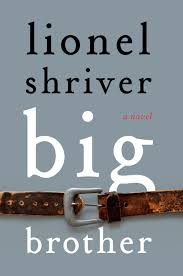
BOOK REVIEW: Big Brother, by Lionel Shriver

I'll tell you upfront. They say I'm a person with issues about weight. Then I look around. I conclude, I'm staying on the horse I rode in on, though it's name is InDenial.   

This novel is a poignant, brutal tale about obesity and its looming presence in the U.S. It's a narrative given by a financially successful sister about her beloved talented brother who fails as a jazz musician and returns home.

His appearance is shocking because he has become morbidly obese.  Even worse, he cannot face the fact that he washed out, and keeps talking about his "glory days" and his come-back plans, to everyone's great pain.

His sister Pandora, married to an increasingly  unsympathetic husband, decides to save her brother and together they undertake a liquid diet that will last 9 to 12 months.  It's a fascinating story, if you've ever dieted, and how they manage to defeat their hunger seems miraculous. 

The story of Edison's graceless fall and his sacrifice, though he will never burn so brightly again, is an acerbic moral tale recommending examined self-acceptance.  

It's a world where we tell affluently-born children they all are the best and the brightest, that they are entitled; and the  have-nots learn their status from the media and want a 29-minute silver bullet fix. 

There's a sort of Midwestern pragmatic craft artisan ethic working behind this story's shell.  Enduring work matters, the quest for satiety is a trap evolution has laid, and just showing up is worth less than it seems, though one can't manage without it. Disappointments will happen, and they are the making of real character.      

I liked this tough read tremendously, yet I have simply not been able to discuss this novel with anyone. My house is made of glass, and so I can throw no stones even though its rooms are full of elephants - targets all.

Reasons for obesity in the U.S. may be much more banal than Edison's plight. Cheap fast food, working absent parents, our biological mandate to choose high-calorie foods, severed from nature and the work of the land, common disappointments, sexual boredom, amoral marketing, the value of an attractive appearance, 
plaque on doctor's office, Beverly Hills
laden with status and power messages, the easy slide into loneliness.


The novel's end is a twist; though Shriver does warn you. Of course, it had to turn out like that.  It's the way the real world is.

Isn't it? 


Wednesday, July 31, 2013

Grammy Camp

Our beloved grandchildren are sent to nursery school, pre-school, pre-kindergarten, transition kindergarten, enrichment programs, gynmastics, sports, art, Lego and science camps. 

They also go to "Jew Day" camps (like pop-up stores) but in parks so no one will be bored during the frequent holidays, professional development days, and extended holiday breaks that pock-mark a private religious school schedule.  

They are kept delightfully busy and happy.  Jack says things like "this is the best day ever", every day! What can you do with urban children? Hillside homes, busy streets, worries about molesters...it's not like my independent Midwestern childhood, when I rode my bike around the small town and played in the woods and Mom really didn't know where I was until I showed up for dinner. I get it, and am glad they have so much to interest them.

So, when Mom has a work opportunity (helps pay for their school and keeps that MBA resumé looking recent),Nannies Lorena or Veronica, or Mommy are sick, parents travel for a quick break, the youngest has to stay home while her elder brothers are busy at age-appropriate theme parks and birthday parties, the solution is: Grammy Camp!  

The children come to our small house, lovingly fitted with step-stools, booster seats, bubble bath, potty, colorful childrens dinnerware, bikes, pool toys, swings, art materials, DVD's, a octopus-size trainset, and two large bookshelves of games and toys.

A loving Grampy presence is waiting, too.  My childless husband has found a starring role as the go-to, hands on grandfather, graciously consenting to be pummeled mercilessly, submerge himself in ball pits, experience bent eyeglasses, and tivo his beloved Red Sox in order to view Snow White - again. 

Sometimes we have Grammy Sleep-Away Camp. The trundle beds have pirate bedsheets and armfuls of stuffed animals and special cuddly blankets.  

It's different here. The toys aren't the same.  No super-heros - just Harry Potter and classic Disney. Squirt guns are allowed.  The lemonade bar is always open. Lots of popcorn. We make boats out of milk cartons like my dad did for me and sail them in the pool. We build contraptions out of toilet paper tubes, blocks of scrap wood, and wine corks. We go to the park and get very dirty playing with water and sand. We run through the sprinklers.  

If you want to stay in your pajamas all day, you can.  Or swim with no clothes, or just wear a pull-up.   You choose all the activities. 

The only rule is no junk food and you must wear sunblock.  


Yesterday Jack attended Grammy Camp.  He is a lithe energy bundle, with a smile that glows from his heart and soul. Scientists say that loving children causes the body to secrete a chemical that results in a feeling of contentment and good will. 

For me, it is like the thanksgiving prayer at Christmas mass, or perhaps a lady bountiful fantasy, distributing profligate largesse with the certainty that it is perfectly given and boundlessly available. 

I remember how much I loved going to my grandmother's old farmhouse, and the sense of freedom, peace, and connection I felt.  I hope our grandchildren have memories like that that will come to them in quiet moments someday, when they have their own children to love and cherish.

These early years will pass, and we will no longer sleep with a crib in our bedroom, need drawers full of modern diapers, or a fleet of riding toys in various sizes.  The boys will study after school instead, turn to peers and independence of action and thought.

We'll be watching, celebrating the time we had, which lifted and humbled us to life, gratitude for its gift filling us with grace.    


Tuesday, July 2, 2013

PERSONAL: A Reading Childhood, Note #1

Summertime meant reading time to me as a child. No one planned field trips, sleep-away camp, or trips to the water-slide park for me.

I got to ride my bike all over our town, to the local swimming pool and the Carnegie library. No one worried that I'd be kidnapped.

Tomah Public Library, built 1916, and considered a good example of "Prairie Modern" architecture
No television programs scheduled to air that night interrupted the flow of the summer calendar. My mother's zinnias filled the dinner table with their bristling energy. Her garden yielded fuzzy green beans and writhing zucchini. 

The secret of effective parenting is to create a closed bubble of filtered reality for that beloved child. Broccoli tastes wonderful when there are no MacDonald's fries to compare it to.

And that's what I got. As rough-elbowed as my family's parenting style was, they did not think they needed to amuse me.  That was my problem to work out.  

The 1950's Midwestern childhood, the stone-smooth cliché of literature, was mine and I lived it heedless. I took a box of Wheat Thins and a new book and spent the hot Wisconsin afternoons enthralled with the power of narrative.


Do you recognize this? No?  Does this help?

How I loved these books. To this day, I cannot put down a mystery. Who did it? Why? And the satisfaction of the ending, and the sweet regret; the suspenseful burden is undone.

I envied Nancy her freedom - a car, an attentive boyfriend, no powerful oxygen-sucking mother. The lesson of Nancy was: she was autonomous, focused on the great world.  And I got that.  

Actually, that was my mother's lesson, all along, now that I think about it.  

Tuesday, June 18, 2013

ART COMMENTARY: Tara Smith & Jessica Hess, Painters

Tara Smith is the curator at the Oceanside Museum of Art, and exhibits paintings at Subliminal Projects Gallery - impressive that she has time to be a productive artist too.  And what a vista to straddle: judge and creator. 

I am drawn to the forward narratives that are a lucid, available, and responsive synthesis, the poignant tandem emotions that arise, and what appears to be exquisitely painted surfaces in her work. (I have only seen internet reproductions.)    


In Untitled (Chopper) I smile and then cringe  at the "helicopter mom" concept and then continue to mull: the Diebenkorn mist that descends to the innocent child could be the wings of his guardian angel, a toxic cloud, or a comment on modern surveillance and intrusions into privacy.

The sweet child plays with a toy that within Smith's image-world, could be a mechanical Shiva - it grooms and saves,and destroys and creates with amoral and over-determined intention.  

What is that yellow-bumble bee section of blade?  I'm musing.

In a recent email conversation, Ms. Smith responded to my questions; she "...loves the balance of subdued color with bright shocks of color."  About the meaning of Untitled (Chopper), Smith wanted to leave it "... up to the viewer and what life experiences each person brings to the work." Interestingly, she said "... that right after I painted the work I felt more doom and now... months from the time when I finished it, I see the work completely differently." 


Jessica Hess
Jessisca Hess, Eureka - Day
 Jessica Hess's subject is pervasive subversion using the symbiotic and parasitic nature of graffiti as symbol. Objects are painted with a saturated photo-realistic style, which at once contains, appropriates, expands use, then denies graffiti by celebrating real figurative painting. I am struck by the elegiac quality of certain works, while others are brash and intrusive.  
Malcom Morley,  Ocean Liner,  1960's
I had to think again about Malcom Morley, whose 60's hyper-realist paintings of crashing airplanes, heroic pilots, and glamorous ocean liners celebrated and questioned the result of 1930's faith in modern engineering and the new globalism - each feat with fewer degrees of separation between nations' contradictory economic development.

I remember too, how much I loved the childrens' books and toys my brother and boy grandchildren were given and played with so diligently,their male gender identity transmitted to them by cultural osmosis.


I especially loved the Tonka book, with its beautiful illustrations of the power of constructive construction and the benefits to us all.  

Luckily, my working mother never tried to shape a female gender identity by forbidding me to play with my brother's toys,  and my generous little brother let me play with his beloved Lionel train set.     


In Galactic Gobbler, 2009, the eerie glow and beautiful menace of a deathly black truck forever enters your personal boundary, its wheels and weight crushing what seem to be small red night driving indicator flags, indiscriminately. 

In fact, in an email Ms. Smith explained that they are brake lights on a freeway, and was thinking about Peter Doig, one of her favorite artists when she painted the last 3" of the work.  (One of mine, too.)

Yet abstract qualities of space appear in varying degrees in the works integrate the figurative composition; in fact I think they are the more compelling experience. It'd be facile to overlook the particular beauty of the painting as one chills with beauty-fear over the subject matter.

  Road Kill Series


I have not felt such a pain when I viewed this painting since I looked at Annette Messager's crocheted shrouds for dead birds at LACMA in the 80's. 

The familiar and cherished poetic insight about "noiseless patient spiders", "flowers in crannied walls", and "the fall of the sparrow" all came to mind with such impact and poignancy, and then a kind of dreadful acceptance, the "formal feeling" that one must live with.    


The theme continues the theme of the forsaken and abandonment with paintings of discarded stuffed animals.  After the Newton school massacre, town officials had to rent a warehouse to hold all the stuffed animals that Americans sent to them in a effort at consolation.  


Teddy Bear - Sam
I have admired Beth Van Hoesen's stuffed animal paintings for some time.  They convey the same sense of childhood loss that I encounter in Teddy Bear - Sam, but the painting technique seems so different.  Van Hoesen's images find the tactile appeal of a stuffed animal, increasing it's intrinsic attractiveness.

My dear mother-in-law, in an assisted living facility, plays with a stuffed animal during the day, and when my own mother died, the hospice chaplain gave me a sweet little bear dressed as a gardener.

I was puzzled and wished that the pain I thought so private wasn't and then flipped to a welcome gratitude that I was so fully perceived.    
Smith also deals with spatial issues in more abstracted compositions, and they seem to retain their California light and air landscape quality. In this intriguing landscape a great white cloud that is perhaps mechanized rests upon dark woods with coffin-like caves visible below ground.


But it's the deep closure I get from its lyrical composition of space, shape and color that drew my attention first and last, and not the narrative that presents itself more subtly than in other works.

I look forward to future work from these two painters.


PAINTING DILEMMAS: A Fatal Addiction to Genre

Howard Post

"…the unending effort to find a balance between sentiment and irony, between beauty and rigor..."

-fictional character Peter Harris in Michael Cunningham's By Nightfall, 2010.

I have invested the natural world  with profound erotic content and transcendent power.  Birdsong, warm sun, distant mountains, tropical islands, clouds: all vessels bestowing endless grace upon my daily climb to maintain footholds that keep me present to life.

Landscape painting seems a worthy attempt when I start in this place. If I paint, I wish the closure's volume to hold a singular position: an informed, mostly unreferential, only slightly polished quality. 

Best words for this:  Japanese concepts of wabi-sabi (imperfect), miyabi (elegance), shibui (subtle),iki (originality), yu-gen (mystery),ensou (the void), kawaii (cute), geido (discipline and ethics), jo-ha-ku (slow acceleration to sudden conclusion.

What's wrong with this painting? I respond deeply to its colors, elegiac serenity, and long vision. 

 But:  it's all too familiar.  It remains an illustration, not a painting.  N.C. Wyeth's "iki" has been appropriated and worked over and through here, and this creates much empathy for me with Post's work: with regret I state the problems that restrain Post.

The reduction of forms perhaps increases and reduces rigor in art; the balance of qualities contains mystery. Observations that nudge before words are made wait for assistance from mentors to formulate expressions of the viewed experience. 

My art knowledge introduces shoulds - there is little complexity in Post's painting, no rigor here, just easy soft pleasure washing into fantasy.

In a NYT article titled "The Paradox of Art as Work", A.O. Scott posits that an artist's job is "…to show us something we didn't know we needed to see."

So, simple, yes? No. Regretfully, I feel no duty to show you what you need to see. It's much more selfish: I want to show what I needed to say about the place I saw, to remember it well. It's always about being struck by beauty.

So perhaps I'm not an artist; my use of art for self and how my self needs it to be don't end with philosophical or conceptual solutions to puzzles, political agendas. My emotional and spiritual needs prevent me from attaining the position of "contemporary artist".  


Tuesday, June 4, 2013

BIRD-WATCHING Ballona Wetlands, Playa del Rey

A Saturday bird-walk in a new location for me, with my new special daughter-in-law, who joined companionably into my deep delight in seeing birds.


The Wetlands is a reclamation project that seems a great success.  We saw quite a few nice birds close up and calm:  ruddy ducks, cinnamon teal, black-necked stilts, great and snowy egrets, a great blue heron, a black-crowned night heron, solitary sandpipers, and a southwestern cave swallow (likely).  Best fun was a giant plastic-looking bullfrog in the shallows, burping at us.  

Then along came two families of Canada geese to splash and play.

ART CONTROVERSY: The Ken Johnson comments


Wherein lies the fault: a discussion of the Ken Johnson controversy

….assemblage was a critique, a subversion, of the formal painted ground when Picasso put scraps of newspaper in his paintings. He did so to playfully but seriously “jeu/jou” (a common Picasso fragment – translates to game/day)  to announce the arrival of a new way/world in art, the avant-garde.  Schwitters used assemblage/collage because little material was available after World War I, and it stood for genesis – that art would be made in any circumstances: poverty, post-war apacalypic  landscapes.  Order would be imposed upon tragedy, disaster.

Rauschenberg used collage/assemblage as a re-defined trope to address materialism and its “thingness”, but also as a referential Surrealist/Expressionist.  He also made it freshly urban, the constant churning of street discards as re-purposed, undying objects, even as one purpose for them dies – isn’t Monogram paradoxical while it is poignant?

To return to K Johnson’s assertion that “blacks didn’t invent assemblage”, I think they don’t claim to.  So? Outsider folk black artists made assemblages all the time, and Mexicans have a vernacular aesthetic called “rasquatche”, the re-use of objects as decorative.  While theses groups and cultures did this, many whites planted old toilets with flowers in their front yards, finding this amusing.  So, this point is really a red herring; it’s purpose to devalue the authenticity of expression of the artists and their work.  Appropriation of mainstream culture’s tropes is a concern – to ape the patriarchs is to assimilate, align with power, a sell out, whether done in naïeveté or intent, it can dilute the seminal artistic intentions of the once-cohesive group. 

For Black artists to use assemblage seems appropriate appropriation.  Pop art critiqued itself by adding irony to the existing images.  (Drowning Girl/Why is it that Today’s Homes…etc.) This even seems brilliant on their part. Why shouldn’t black artists do this brilliantly too. 

Johnson seems to think that this direction caused black artists to be marginalized by  the mainstream art market.  Alas, it’s far simpler than that.  There was just too much assemblage/appropriation going on, and it had already peaked with Rauschenberg.  So, the art made had to rely on its politically correct solidarity (a questionable assigned quality, in my book) and its haunting reminders of the crimes and atrocities of racism perpetrated by citizens of “…the land of the free.” – not so many whites want to step up to judgment  when it comes to facing the hypocrisy of  the American lifestyle and values.  The carpet is very crowded with candidates, all declaiming, “not me, I  didn’t do it, I had no choice – the most incriminating confession of all.

So no wonder the market didn’t just step up and pay out.  Maybe if the National Guard had been ordered in, it might have.  But then art is not an emergency, a fact to keep in perspective, and keep those of us who love  and live it humble.

So what ‘s the problem with Johnson?  He seems incompletely informed, to have made opinions that excluded perspectives and historical data that most critics would know  - items I’ve mentioned above that  I would have thought anyone would have considered.  So, Johnson seems to expose covert limitations on aesthetic valuing of Black and women artists, but, oh, look, they are his own as well. 

But Johnson seems to be accusing the mainstream art world justly even with his own amputated opinions – the shadows of racism are long  indeed.

Johnson’s issue with women’s art is similar.  He suggests that some women make “women’s art”.  What is womens’ art?  We all know it when we see it.  Sentimental, pretty, decorative, ragingly hormonal, feminist, dikey, with being defined. with self-objectification, identification with the other.. Well, there’s all that trashy landscape art with dogs and cows from French neo-classicism, the really cute baby Jesus paintings,  the violent sadism of Italian painting-especially those St. Sebastian paintings – I hate those! sentimental imagery of clean peasants working the land, de Kooning’s dominatrixies; homo-erotic wrestling matches and dying pretty boy sculptures; textiles abstract tesserae and tile designs for architecture mostly all created by men, …shall I quit now?

I would think that womens’ art is rejected because of its poignancy.  Women crochet toilet-paper roll covers (and men fix cars) out of innate human needs to use the hands, to create, to fashion.  It’s the fault of society that class determines the form of expression that is available to the members of any given society. 

The hierarchy is not comfortable with these reminders; it guilts them and its evidence of their subjugation of classes. 

That said, the work exhibited in “The Female Gaze”, though some deals with images of women and children, or uses traditional craft materials, does not look like a Midwest gift shop.  A viewing perspective, intended by the curators, is what kinds of art do women make? Is there women’s art?  What do we mean by that?  Why are they underrepresented?  All worthwhile questions, besides reflecting on women’s special biological role and its compelling paradigms and contributions to human society – a reflection to made about male roles also.

David Levi Strauss in Art in America  says a “new critical language” (March 2013) is needed.  In the last 40 years, various perspectives for criticizing art have emerged based on queer theory, women’s studies, psychoanalytic reading, Marxist criticism,  can you think of a few more?  He doesn’t describe much about his brave new language, and I think it’s the least he owes us, after his PC article about Ken Johnson, who I still think is just a bumptious critic and probably shouldn’t be attended to in the first place, but for the usefulness of parsing race and gender issues as they present themselves afresh.