Sunday, December 11, 2016

LACMA: Three Experiences of Perception and Perfection: Zen Painting, James Turrell, and John McLaughlin


The Japanese Pavilion at LACMA is hushed and dim. Few people enter it, despite the unquantifiable influence of Japanese art on the west. One is already a seeker when one enters here.  

I wish I liked the pavilion better. Architect Bruce Goff was Frank Lloyd Wright-inspired and trained, but what comes of this is a mini-Guggenheim trying very hard, showing it, and controlling the experience of viewing in an almost unpleasant way.  I will leave the disappointment here to record how much I loved seeing the exhibit, "Japanese Painting: From the Zen Mind". 

It's getting to meet a panel discussion of some great Zen masters, encountered and read by Western artists and writers who turned to the east and were profoundly redirected.  

Remember this?  "What is the sound of one hand clapping?"  I was in high school when I encountered this Zen koan, and surely to most of us it is a cliché, long drained of meaning because usurped by pop-style conceits related to the craze for all things"oriental".  The koan was actually written by a Japanese Zen monk, Hakuin Ekaku (1685-1768). The painting at left, by Hakuin, is of a birch rod, which zen trainers used on inattentive sitters at zazen to assist them to attain enlightenment.  I am sure it was a great help. It was presented to a student upon "graduation" from  monk's training.  The painting is speedy, bold, casual, slightly awkward, utterly and effortlessly sprung from long effort at calligraphic accomplishment.
Hakuin struggled for many years to attain enlightenment and finally concluded that whether or not he had done so, he would teach - his dharma was as a boddisatva (Buddhist saint), delaying the attainment to assist others to find it. (His biggest problem, it sounds to me, was to commit the Zen sin of trying too hard - though he became legendary, his satori was much delayed.)

Hanshan (Cold Mountain) was a Chinese hermit/monk/traveler in China during the late 8th-9th century CE.
He and his friend Shi-Te traveled around China joking and fooling around, appearing feckless to many, but living a Zen life.  He and Shi-Te are the authors of a body of poetry called Cold Mountain Poems, often the subject of calligraphic scrolls. 

Jack Kerouac dedicated "On the Road" to him at Gary Synder's suggestion (Synder among the first translators of Hanshan), and in another book by Kerouac, "Dharma Bums", he and his buddy pal travel around impersonating HanShan and She-Te. No one recognized them until he revealed this in the novel, however. (Thus the prior reference to styling oneself zen, and the seminal buddies-on-the-road narrative genre.)
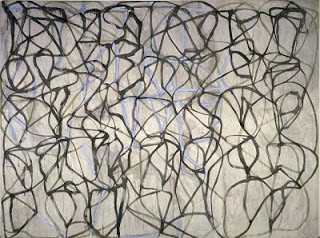
Brice Marden,  Cold Mountain

 Of interest is Brice Marden's encounter with HanShan's poems and Chinese calligraphy. He worked with the ideas and appearance of calligraphy to make a group of works called "Cold Mountain". Though they had little to do with the subject matter of the poems, they are most certainly Zen in the manner of their  becoming.

Fūgai Ekun, another Japanese hermit/monk, made images of Hotei,one of the seven lucky gods of Japan crossing a stream. Hotei carries an empty cloth bag with which he feeds and gifts acquaintances and which is never empty - is he Santa?  How could I not find a philosophy that is funny persuasive?  Didn't hear the Catholics laughing, but maybe I missed it. 


 The next artist, a Buddhist nun, had to move constantly because was hounded by her public and their demands for her work interfered with her ability to make it.  


Ōtagaki Rengetsu, (1791-1875)  "Mountain Crows" 

This is the only photo I was actually able to take because of the gloomy interior of the Pavilion, ostensibly lit as Japanese would light a museum for viewing. 

By this time the zen poetry was writing itself.

My steps were planned for me
sloping ramps
branching pathways
in gray fog gloom.
Peer with aged eyes
at treasure
Always new. 


"Want to know where the cloud way lies?
 It's there, in the center of the void."


Torei Enji
Torei,a student of Hakuin,(1721-1792)wrote The Undying Lamp of Zen.   The Void, Emptiness, was a constant, to be accepted, sought, and not known. 

Then I moved from the Pavilion into the crisp and warm early afternoon sunlight to James Turrell's Ganzfeld (Breathing Light). It's a large empty room up the stairs in which only cinematic projected light is all around the 15 permitted shoeless occupants.  The light ranges from pale tones to deeply saturated hues, none darkened by complements or shaded with black.  If there is a place that is empty yet full, embodying the contradictions of perception, this room is it.


It's a beautiful, unusual experience, easier and cheaper than getting up to see sunrise on Haleakala - you need tickets for that now, too.  The changing light is soothing, slow, slowing down the mind and breathing, marveling at the beauty of LED light.  Manufactured, artificial, mechanically powered, wasteful of energy. But still, unforgettable.

It's a long way to Chartres, and it was a long time ago. The stained glass survived WWII, and it is so blue, like no other blue attained by man's creative hands.

Chartres Cathedral stained glass

Then I scored a cancellation to Light Reignfall - a marvelous body-mind experience rather like an MRI for artists; the only diagnostic result is self-induced. Lying on a cot, my body is rolled into a round bathyscaph.  I chose the "hard" experience this time; last year I'd done the "soft". "Hard reignfall" was/wasn't unpleasant, but demanded, stretched, implored my attention with loud, banging beeps, bracing fast color changes laced with piercing white lights.

I found I was a very diminished person this time around.  The double cataract surgeries I had last year have left me with lots of "floaters", mostly unnoticeable in normal light but which cluttered and glided across my vision cones as I attended to both the Turrell installations.

Glaucoma is genetic and also a complication of diabetes, as is diabetic retinopathy, a deterioration of vision.  If the reality of dialysis and neuropathy aren't enough, the loss of vision is.  An artist will be blind.

Maybe we already are.

When John McLaughlin began his life in art, he said that when he looked at Western art, the artists were telling him who they were. With Eastern art, they were asking him who he was.  Yet he didn't enter a morass of psychoanalytic examination.

"Barrier: to get through it,
follow the pathless path".

He lived in Japan from 1935-1938, studying the culture,ran a Japanese art gallery in Boston, learned Japanese in Hawai'i and served as a translator in World War II.  Self-taught, he was inspired by the monk Sesshū (snow boat) Tōyō (1420-1506), a famous Zen painter fascinated with the concept of the "marvelous void."

He began painting the 1930's and quickly turned to hard-edge geometric minimal abstraction.

He wrote: "With respect to my direct influences I must stress my interest in 15th and 16th century Japanese painters. I have found comfort in some aspects of thought expressed by Malevitch, and I am indebted to Mondrian because his painting strongly indicated that the natural extension of Neo-Plasticism is the totally abstract."[4]  (Wikipedia entry)


John Mc Laughlin late paintings and a Roy McMakin chair - an invitation to the dance.

"My purpose is to achieve the totally abstract. I want to communicate only to the extent that the painting will serve to induce or intensify the viewer's natural desire for contemplation without benefit of a guiding principle. I must therefore free the viewer from the demands or special qualities imposed by the particular by omitting the image (object). This I manage by the use of neutral forms." (Wikipedia entry)


Several artists discuss McLaughlin in a video; to me the seem to muddle around, finding few words to help attend to McLaughlin's work.  "So close to perfect"...he had a really good journey...a rigorous spiritual practice...paintings are about the figure/ground relationship...more organic than mechanical...(Grotjan examining the non-mechanical quality of the edges, lines, and color planes).


Only Venus and Mars
attend this early morning 
Clear in the dawn light.
Look away
And they are gone. 


Thursday, December 8, 2016

Globalism in Art - How to See It, Find It, Is it Possible?


No.  But we can try.  But I'm depending on the art establishment to show it to me.

from the New York Times, 10-30-16, Holland Cotter article

... in the early 1990s, the contemporary-art market fell apart, and some gate-crashing occurred. Artists who were once denied entry, many of them nonwhite, came in. So did new kinds of art, much of it with roots outside Western traditions. An expansive new age of globalist art had begun, and it felt excitingly utopian. By forging links among far-flung people and cultures, art could do what politics could not: bring everyone to a communal table for share-the-wealth feasts, with museums serving as hosts.
In the years since ... globalism as an ideal, in the 1990s sense, faded somewhat from view. The proliferation of international biennials and triennials dulled its edge. The concept had become shopworn from use as a marketing tool. And when globalism became confused with economic globalization, political questions arose: To what extent does sharing dilute difference? Who’s in charge of building that communal table? Who decides the seating?
Recently, globalism, as global consciousness, has come back into focus...

Gloria Steinem Interview KPCC with Alex Cohen

"...female authority is associated with [non leadership qualities]"

 "women are uncorrupted by power"..."Sex and World Peace" book documents how  ...violence against females is the major indicator of an unhealthy dysfunctional society...


"I think we need to look where we are... So if we make every day a day in which we have increased that kind of balance, for instance if we have at least listened as much as we have talked, or talked as much as we have listened and created that balance. If we have looked at the groups around us and said how come this group isn't [as] representative as it should be. If we have made sure there's laughter and music along the way. You know, so I've learned that to agonize and think only about the future is to give up a chance to influence the future by what you're doing right now."
On how to find hope, for those who look at this moment as a time of despair
"I think clearly we need to look laterally at each other and not up at the White House. When we look up, we feel isolated. When we look at each other, we realize that we are the majority— even of the popular vote, that was in Hillary Clinton's favor, and also if you look at public opinion polls of the issues. All the issues that [Donald Trump] opposes, the majority of Americans support. So that is very heartening, and we realize that we have a lot of people power, and there's much that we can do."

Tuesday, November 22, 2016

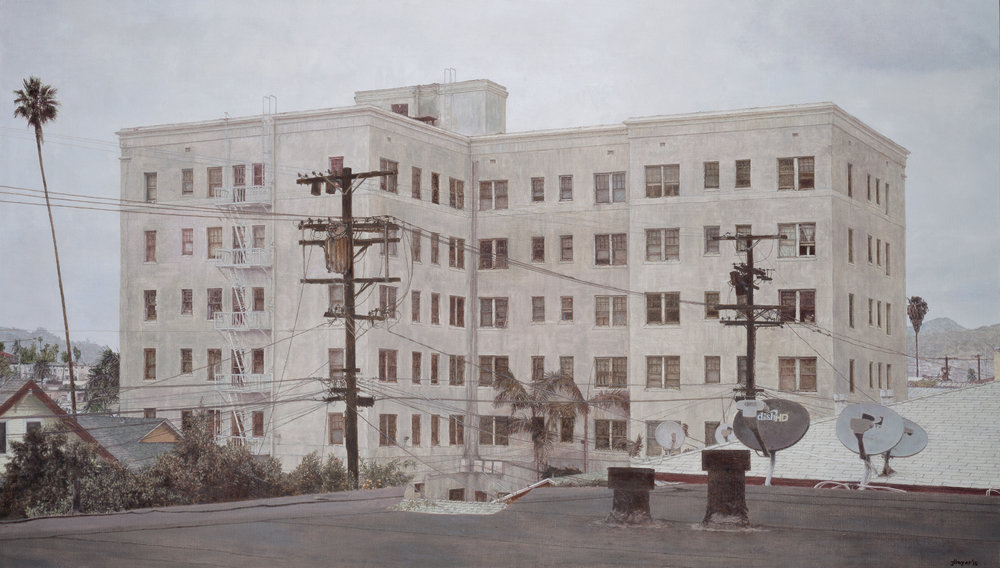
ART: Jack Hoyer


Wilshire Center Building, 2015

I have a book of postcards from the '50's titled "Boring Postcards". I have always kept it because its images stifle and suffocate with the knowledge it's much too late to escape the built world. 

So, like Thom Gunn's motorcyclist, I am a runner, an escapist, seeing comfort, solace, distance, quiet, kindness,atonement. I have a studio, a room of my own.  

I must go see these paintings.  They seem to need to be in the book.  That sandy dulled quality of light, like 50's smog, the sense of isolation - no one cares about these places, no one is looking at these scenes yet they have import. 

Rebecca Campbell has said, I think, that physical and intellectual nostalgia is a path to the sublime. Reality and the demands of social adjustment take far too much from my meager energy - all the threats are too close, my boundaries as lost as the spaces in this painting.


Sunday, November 20, 2016

WILSHIRE COURTYARD BUILDING/JAPAN FOUNDATION Exhibition "Yakishime" Ceramics


Wilshire Courtyard, 5700 Wilshire Blvd.
This building (1987) has always intrigued me as I drive down the Wilshire Corridor.  It seems to have inspired by Middle-Eastern ziggurats, or Mayan temples, both references aligning with our Mediterranean climate and geography.
But to my eye, it's a bit glamorous, very  elegant, and reminiscent of other dominating examples of LA city business architecture. But LA is definitely about glamour, so it's an easy acceptance.

It is beautiful, marble-clad, the right-angled set-back layers opening the building up to SoCal blue skies.  The interior courtyard, reception space, and interior garden/courtyard remodeling going on now,(by Michael Maltzan) is welcoming and truly special.  A farmer's market was in takedown mode as I strolled the arcade that divided the two buildings to find the Japan Foundation.  I was seeking a ceramics exhibit that I wouldn't have to drive to to Pomona for.

The sparkling atrium is soars, somehow feeling like art nouveau conservatory domes but so pristine and modern - and the warm sienna tones of the interior walls contrast so beautifully with the blue blue sky.  


(from Michael Maltzan  website)
A LANDSCAPE PATCHWORK QUILT
The courtyard was conceived as a planted tapestry of colorful and playful topographic elements.  This “patchwork quilt” is composed of a field of vibrant flowering plants ...
Further enhancing the three-dimensional nature of the patchwork are three large shade trellis structures.  Clad in custom white perforated metal panels, these pavilions support brightly colored bougainvillea to provide a cool, shaded gathering spot during the summer months...   courtyard elements, along with the meandering pathways, seating areas, and vivid signage, create a continuous visual experience that.. unite[s] the two courtyards.  

I loved walking diagonally through the courtyard, admiring the distinctive white perforated gazebos with vines sheltering dining tables.  White framed raised flats were filled with yarrow, iris (in November!) and other perennials, all at peak display.  It feels like strolling a public garden plot space, and it's uplifting to move through, softening the urban character - yes, we still have some space for nature in this city.


The Japan Foundation


The Japan Foundation is a new find (ad in LA Weekly) tucked along the road dividing the Courtyard's two buildings. It houses a small select library (including manga) devoted to Japanese language and culture, a gallery, and sponsors events of interest to lovers of Japan, language students, and prospective travelers.   Hours are limited - do check ahead. 

Yakishime Pottery


This pottery was once used daily by farmers, and its origins date back to the 12th century.  The surfaces are rough, and the iron contained in the clay, along with the unique glazing character caused by the special kiln, added color and texture not directly applied, yet intended, by the ceramicist. Most fascinating, it's unglazed.  The surface is vitrified by the heat of the kiln, making it waterproof.

The Japanese aesthetic sense has always moved me for its sensitivity to dailyness and  harmony - a centered place to contemplate nature's infinite beauty and complexity.  I love, too the valuing of humble, subtle, aged surfaces that cherish time's record upon the surface and form.

Yakishime's heritage is expanded upon by  the beautiful booklet provided near the gallery door. These are two examples are used for serving "washoku", Japanese cuisine, designated an "intangible cultural heritage treasure" by UNESCO in 2013.


I have known and admired raku pottery for some time, but this technique is new for me.
Black rectangular dish, Isezaki Jun, 2015

Isezaki Jun, the second son of potter Isezaki Yōzan, is one of the most renowned masters of Bizen pottery, a traditional ware that emerged nearly a thousand years ago in the Inde district of Bizen, Okayama prefecture. He is the fifth artist of Bizen pottery to be designated a Living National Treasure by Japan’s Agency for Cultural Affairs.
Isezaki brings back the anagama traditional kiln form, that is dug into a hillside like a tunnel. Of significance in Bizen pottery production is the yakishime style glaze - glazes that are the results of natural wood ash and burn-products that occur in the kilns during the firing process. Isezaki therefore emphasizes the importance of the placement of his works inside the kiln. Even as an experienced potter, the artist cannot completely predict how the works will turn out; the firing process often brings out unexpected beauty that even the artist does not plan. The finest works are often results of the combination of careful design and fortuity. Isezaki’s works, which have bloomed from tradition, continue to emerge and expand in exciting new ways.
His works have been exhibited and collected by major museums in the world such as by the British Museum, and the Museum of Fine Arts, Boston.  - from Onishi Gallery website 
Kakurezaki Ryuichi "So" (Pair), 2015


Kakurezaki Ryiuichi is a highly celebrated contemporary ceramic artist whose exhibitions in Japan often sell out within minutes of opening. Kakurezaki was born in Nagasaki on the island of Kyushu, and now lives and works in Imbe, the ancient home of Bizen ware. He has the advantage of being viewed as an outsider in Imbe, allowing him to experiment in ways that most of the other 500 potters working there cannot. While he works within the tradition of Bizen, his work is quite aesthetically different from conventional Bizen wares. His fresh and independent vision has inspired other potters to contend with classical forms, and has already established a standard of his own.

“I do not intend to create something avant-garde in the Bizen style. My works are always functional, and I create ‘crafts’ that are indispensable for everyday life. I think it important that professional potters should create something in response to the needs of our society. My preference is to be seen as a craftsman whose work is avant-garde, rather than an avant-garde artist.”  - from Joan B. Mirviss LTD gallery website   
Ichino Masahiko, "Tamba Dokai" (A lump of Tamba earth), 2015

above work, second view

Ichino Masahiko, born 1961, is represented at LACMA, and is a "star" of Japanese pottery, winning celebrity and prizes. He is a noted creator of Tanba/Tamba ware, named for the ancient kiln and its location. 

Tanba Ware ... is also called Tanbatachikui Ware which was appointed as the Japanese Traditional Crafts in 1978. ..The Anagama (the kiln of a hole on the side of a hill) was used once...
In the Edo era, climbing kilns imported from Korea increased the numbers of vessels to be fired at a time. Through the firing for 70 hours at the temperature of 1,300°, the pine wood ash fell into vessels and it reacted to the glaze, which lead to the unique phenomenon, “Ash Overburden,”, resulting in various colors and unexpected patterns.... A feature of Tanba Ware is to make the potter’s wheel counterclockwise.
Ceramic arts made from clays with rich iron under the graceful scenic environment of Tanbasasayama area, emitted a distinctive bitterness... Tanba Ware is rich in the shapes and colors of dark brown and black. The austere taste of Tanba is always praised by many ceramic lovers. -from website japanpottery.net

Mihara Ken, "Kei (Mindscape)", 2015


When I saw this piece I thought of Frank Lloyd Wright and the Guggenheim, and Frank Gehry's soaring celebration of human mastery when I see this artwork, and of origami, another gentle art.


Mihara Ken's (b. 1958) unique style is the culmination of a thoughtful dialogue between potter and clay.  Using materials from his native Shimane prefecture, Mihara constructs each work through an organic creative process.  His hand-formed works possess a strong linear quality while at the same time incorporating soft, delicate curves to create a unique combination of subtlety and solidity.  Elegant shapes, often drawn from ancient forms or more currently inspired by the tradition of origami, are fully sculptural and successful from every vantage point.  With repeated firings at high temperatures, the surfaces of these vessels radiate subtle and soft colors ranging from deep gray to peach to misty white and purple. 

While younger than most of his equally prominent colleagues, Mihara is able to convey in his vessels a confident design sense, sophisticated style and brilliance of execution of a far more mature artist.   
Selected Public Collections:

Asian Art Museum, San Francisco, CA
Brooklyn Museum, New York, NY
Los Angeles County Museum of Art, CA
Metropolitan Museum of Art, New York, NY
Museum of Fine Arts, Boston, MA
National Museum of Modern Art, Tokyo
Peabody Essex Museum, New Haven, CT
Philadelphia Museum of Art, PA
Victoria & Albert Museum, London, United Kingdom
Yale University Art Gallery, New Haven, CT


 - from Joan B Mirviss LTD gallery website


Otani Shiro, Fire-colored Shigaraki jar, unknown period

Born in 1936, Otani worked for many years in the Shigaraki kilns, studying more than once in the U.S. His work embodies the aesthetic concept of "wabi cha"  (related to tea ceremony wares), the "chilled and withered", to hold in high regard work that is humble, honest, rough, simple.  The works are unglazed and dependent upon the unique quality of texture the Shgaraki clay displays after many days at high heat in the wood-fired kiln.

... This idea of harmony, which eschews the supercilious and egotistical in favor of the subtle and unassuming, forms the cornerstone of Otani's idea of beauty. This kind of harmony, however, should not be confused with the easily appreciated, predigested sort of beauty that lacks psychological texture and emotional tension. Instead, it is much like the imperfect perfection of nature--fragile, raw, full of contradictions--that is never redundant and always compelling
In the United States Otani's work has been collected by The Fogg Museum at Harvard University, The Brooklyn Museum of Art, The Museum of Art in Atlanta, and the Arthur M. Sackler Gallery of the Smithsonian Institute in Washington, D.C.


Isesaki Koichiro "drops", 2014

This is one of a group of small rounded empty-center forms which seem to cluster together in relation yet so distinctive. It's easy to see this group containing metaphor, but mostly I smile a bit as it seems gently amusing and yet so calm.

This ceramicist was born in 1974, and is a son of Isezaki Jun, whose work is shown above. He studied in New York with Jeff Shapiro, who lived in Japan for 9 years beginning in 1974 and is an impressive ceramic artist himself.


Tanaka Tanome, "core", 2006

My pieces are consisted of many lamellas of clay that are attached on the surface of the hand-built clay core. .. the layers... getting all my feeling out madly... my interest was shifted to create the forms that have beautiful curved lines, like waves...
The anger, happiness and other feelings are always mixed and whirling in my mind... Now, I consciously create the pieces that are not only expressed my inner feeling, but also are born from me as new life-forms. -from Keiko Art International website artist statement

I thought of doves, of wind-cut, water-carved stones, of seaweed moving in currents, of thinnest skin tissues, of fishes fins determining direction. I hold my breath that a lamella doesn't detach, that there seems no imperfection in the joinings, unions, and navel-like spiral fin origins. Such impossible elegance, simplicity, complexity.


Kyoko Tokomaru

For whom do flowers bloom?

White flower has pure, vital power, rebirth power, and eroticism.

Born 1963, she has worked in the United States extensively.   Kyoko Tokumaru’s porcelain plants blossom forth with restrained energy, her spiky lances and unfurling fronds forming fantastical botanical creations. The artist begins with slabs of clay and then constructs them to create work rooted in existential explorations. In this regard, Tokumaru notes that her spatial expressions allow her to travel deep inside herself. Describing the experience as “an accumulation of texture,” she explains that she can feel her inner emotions being transferred into the clay through the touch of her hands. Tokumaru holds both a BFA and MFA in ceramics from Tama Art University, Tokyo.

I found this object off-putting and breathtakingly static, at the same time drawing up in astonishment at the exquisite detail and precision of the form. Other work by this artist is asymmetrical, or moves horizontally, crawling with tentacles and interwoven organic forms. Surreal and slightly threatening. How white does imply a barrier!


It's a long way from humble Bizen yakishime ware to this creation. I remain astonished and celebratory as I think of the beauty of form in these objects, so poignant as they wait to be seen.  

Monday, November 14, 2016

FILM: Guillermo del Toro Exhibition, LACMA/Lezley Saar/Rosamund Purcell


Artists pursue the negative sublime - yet again.

It's elemental to confront the beast, the monster, the experience which no human life experience escapes.  
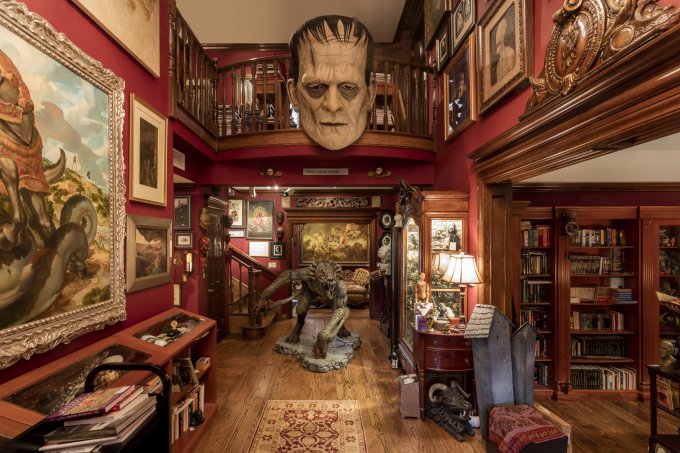
Foyer, Calabasas home called by Del Toro, "Bleak House"

I have not been a fan of the horror/goth genre, though noir is a fan niche. I tried to see "The Exorcist" in 1971, heavily pregnant, and ended up sitting out in the lobby, where I was chatted up by a fellow escapee.

I read lightly through the grisly descriptions and plots required in my favorite crime novel genre, and avoid some.  

I do pride myself on owning a decent understanding of "the negative sublime", and the desensitization/sublimation defense mechanism, which I apply liberally like mental mosquito repellent at regular intervals. 

Film is a powerful alchemy of cinematic tools which aestheticizes images of primal wounds and scenes, eroticizing shock and awe.  The experience of physical pain and the resulting trauma is somehow demetasticized. I can then claim to possess a sanguine perspective that mostly remains in position as required by the goal of social adjustment.
personal notebook/journal

I would have passed on the exhibit but for the request of my 10-year old grandson, a creature of surprising autonomy of interests and tastes.  He saw the LACMA flyer at our house with an ad for this show and immediately asked to see it.  We've pretty much done "Metropolis", Streetlights hide-and-seek,that green string maze, and he's too young to recline in Robert Irwin's mind-bending bathyscaph light show.

I'm quite glad I didn't.  I would have missed an artist who tops out far and above the goth genre, working from Mexican literary/visual surrealism, the rich trove of cabinet-curiosity object-imagery, digital special effects and its possibilities, and iconic past horror films. 
Max in background using interactive iPad display

It's his granular, intense distillation of image that stuns. For instance, a clip of writhing octopus-like internal digestive organs, gave me a "made-you-look, grossed you out" moment. Winner! - the artist. Having sensory input is a valuable survival adaptation, but it does permit intrusion, violation. Bad smells, sounds.  Experience, repeat.  Efficient fight/flight mechanism in place. Thank the Creator for this.

Max took it all in, sometimes mildly amused.


The frightening black widow - I loved this dress.
model of actual "freak" show performer Johnny Eck
model by Richard Kuebler

What the world made of him then, what he made of himself.  He folded his lower body to create the appearance of having none.  He walked on his hands before he was one year old. He appeared in a 1932 horror classic, "Freaks".

Verisimilitude and unlike/like objects: Joseph Cornell and the movies blur existence. 

The exhibit is very large, and I determined to watch del Toro's films, past and future.  But I couldn't bring a die-hard or even medium fan familiarity to it and so I glazed over, sliding through the rooms zapping my eyeballs and observing what Max chose to look at. A perfect LA exhibition.


The week before I'd attended a presentation by Lesley Saar, daughter of iconic African-American artist Betye, age 90. In her own deeply personal way, she too responds to the divergent, macabre states of body and mind, delivered by an unkind fate, burdening the recipient with a hard road.  Her son, born with autism spectrum, still living with the family at 24, is also transgender.  

And she has lived the other, as a mulatto American born in 1953.  Her work draws heavily from literary sources and depicts  anthropomorphic, fantasy portraits of the singular individuals she perceives.  I was reminded of the film, "The Elephant Man", with John Hurt, the one best film about the pain of bodily disfigurement I have ever seen.


Lesley Saar, "Cell Realization", 2014
   The macabre goth horror genre is big right now. I have recently written about Rosamond Purcell, and I wouldn't want to exclude Cornelia Parker.


Cornelia Parker, "Psychobarn", 2016 installation in the Metropolitan Museum of Art's Roof Garden

Parker is a British artist whose work is driven by the intuitive unconscious.  This work is a mash of Edward Hopper and the house from "Psycho", rebuilt as a stage set from an old barn.  Striking and haunting against the skyline, it's scaled to fit against it.  A goth version of Main St. USA. Beautiful textures.