Sunday, January 22, 2017

Painters Louise Belcourt and Justin Margitich and abstracted landscapes

To Be:  Liminal -- how to arrive at this delicate place?
.
"...the liminal spaces of perception"    

What does "liminal" mean?  I thought it has to do with light, illumination that provides perspective. Something elevated, spiritually pure, rational, intentional, unlike its scary opposite, subliminal, with its 50's brainwashing reverb, its paralysis of analytic insight.
Liminal, it turns out, is actually simpler:  

liminal |ˈlimənl| adjective technical 1 relating to a transitional or initial stage of a process.2 occupying a position at, or on both sides of, a boundary or threshold. (New Oxford American Dictionary)
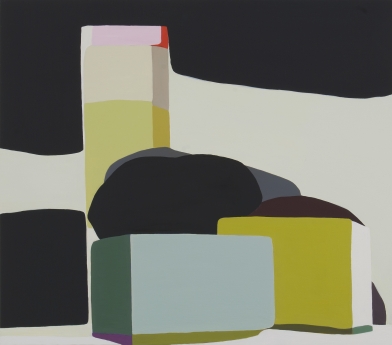
Louise Belcourt Locks Gallery Painting Mound #18
Louise Belcourt, Mound #8, 2015
The word was used about the work of Louise Belcourt, a Canadian artist who lives in urban Brooklyn and rural Canada.  I immediately loved her paintings.  They are easy.  I love her colors. Oh, that pea-soup army green, the delicate lavender, the blackish voids!  They are colors of haute couture fashion, perhaps found on scarves, textiles, or area carpets placed in cool Manhattan high rises.


Lamb's Ear #5, 2016
Blocky shapes pile upwards from the horizon line at the bottom edge of each canvas and coalesce into abstracted vistas. Belcourt utilizes an organic approach to perspective and sophisticated shifts in color to render depth, space, and atmospheric light. The liminal spaces between the tightly packed fields of flatly applied color function as alleyways from foreground to middleground. ... I recognized the images as completely imagined places assembled using the language of landscape painting, rather than relating to the real world around us. (from website artblog: Imaginary Vistas-Louise Belcourt at Locks Gallery)

Belcourt’s paintings explore the intersections between the built and natural world. For her first show at Locks, the artist presents new oil paintings of architectural “mounds” in shifting spatial planes—what she calls “paintings of sculptures of landscapes... her paintings, which blend impressions of the countryside and crisp Canadian light with city rhythms and the blocky architecture of New York City. Belcourt’s imagery evokes forms from prehistoric “mound-builders” to urbanization, while creating a visual language distinct from a purely representational or abstract syntax. ..Using bold colors, radiant light, and dynamic perspectives, Belcourt’s images of tectonic landforms—stacked, occluded, and cascading into foreground and background—meld nature and man-made forms, reflecting an ecological awareness and heightened sensitivity to the world around usJuThe artist employs a directness, physicality, and visual clarity in her paintings that feels increasingly rare in our media-driven digital age. (from Locke Gallery website).

The writer comments that, despite the contemporary palette, the paintings have no references to digital culture.  The painter and the paintings act as visual mediator, cleared of digital processing. 

I guess that makes her a romantic, and possibly irrelevant to contemporary art. I think she's moving wonderfully in the formal issues of painted abstraction, still grounded in earthly splendor.  

We could go for a walk in her paintings, the forms of nature reduced to mounds, meanders, and structures that shift the relation between self and world, like entering a well-proportioned home.   

In painter Justin Margitich's new show, "A New Sublime" at Moskowitz Bayse, the artist seems to embrace digital forms, according to the gallery commentary.  In the painting below, fluid ribbons struggle to escape the clinch of empty and connected "frames",  (television screens, film frames?)     


 Justin Margitich  Iridium #3 , 2014 Acrylic and colored pencil on paper 24 x 24 inches  

Justin Margitich
Iridium #3, 2014
Acrylic and colored pencil on paper
24 x 24 inches
 Pieces on panel painted with acrylic, heightened with graphite, express brightly hued linear gradients that both expand and contract in space; works on paper mounted to panel echo the wildly colorful line work, while adding the complexity of organically fluid forms. Across media, the artist’s compositions make use of a world of color that goes far beyond secondary and tertiary while simultaneously resisting muddiness, creating a near impossible balance. Together these paintings present a series of spaces unseen; bizarre and foreign vistas of arcane forms that resonate at once as eerily familiar and strikingly unknowable.
Justin Margitich meditates deeply on natural forms in a digital world. His paintings distill and fracture landscape, creating a formal language that challenges common perception of perspective and logical space. Margitich reconciles vanishing notions of idyllic landscape with our growing reliance on digital technology in a cohesive aesthetic act, creating a new sublime image. (from Moskowitz Bayse website)
 Justin Margitich  Variations 15 , 2016 Acrylic, watercolor and paper on panel 30 x 22 inches  
Justin Margitich
Variations 15, 2016
Acrylic, watercolor and paper on panel
30 x 22 inches
In "Variations 15", two ovoid globes just begin to touch, the frisson seems to blacken and burn, overlaying the radiant content, like a piece of film burning.

 Justin Margitich  Derivation 3 , 2016 Acrylic and graphite on panel 36 x 36 inches  
Justin Margitich
Derivation 3, 2016
Acrylic and graphite on panel
36 x 36 inches


"Derivation #3" references light shafts, fractals, or perhaps rockets taking off? Shapes are juxtaposed, overlaid, interwoven. I mistrust myself when I  find such narrative material in painting.  I cringe because I think of all the artists I've heard explain that there's no there there.

And as Steven Alexander explains: discerning meaning in a painting is not the same as reading a narrative. To regard a painting simply as a text is to ignore the extreme complexity and the mystery of non-sequential interactions that take place in the inclusive realm of aesthetic experience. (from his blog post, 5-18-08, "Meaning and Abstract Painting")

Just the casual viewer puzzling through his abstraction encounter, making a guessing game out of enigmatic figure/ground relations.  Not that it's the painter's fault, it seems more a failure of my own perception here. 

Margitich's agenda is formidable - to explore the digital sublime, and resolve it in painting. To me, his paintings remain cool and aloof,incomplete passes at a goal worthy of further attempts. 


Sunday, December 11, 2016

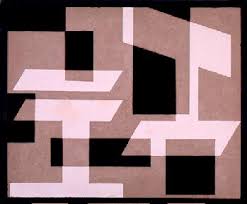
John McLaughlin: Hard Edge, Minimalist Abstract Painter


A new exhibit of this artist's work at LACMA, as revealing and compelling as was the Agnes Martin retrospective.  John McLaughlin is another artist summoned to Eastern philosophy, yet convinced that with Western geometries it was possible to convey the astringency, reductive simplicity, and stillness of Zen.  


1946, Norton Simon Museum


I have not identified every image in this posting. Almost all of them are my own photos, arranged chronologically, and since most have no titles, I simply want to look at them and enjoy the progression, variation, and direction which McLaughlin expresses in his painterly journey to the void.


1947


He lived in Japan from 1935-1938, studying the culture,ran a Japanese art gallery in Boston, learned Japanese in Hawai'i and served as a translator in World War II.  Self-taught, he was inspired by the monk Sesshū (snow boat) Tōyō (1420-1506), a famous Zen painter fascinated with the concept of the "marvelous void."

He began painting the 1930's and quickly turned to hard-edge geometric minimal abstraction.

He wrote: "With respect to my direct influences I must stress my interest in 15th and 16th century Japanese painters. I have found comfort in some aspects of thought expressed by Malevitch, and I am indebted to Mondrian because his painting strongly indicated that the natural extension of Neo-Plasticism is the totally abstract."[4]  (Wikipedia entry)
1948


When John McLaughlin began his life in art, he said that when he looked at Western art, the artists were telling him who they were. With Eastern art, they were asking him who he was.  Yet he didn't enter a morass of psychoanalytic examination.

"Barrier: to get through it,
follow the pathless path".


"My purpose is to achieve the totally abstract. I want to communicate only to the extent that the painting will serve to induce or intensify the viewer's natural desire for contemplation without benefit of a guiding principle. I must therefore free the viewer from the demands or special qualities imposed by the particular by omitting the image (object). This I manage by the use of neutral forms." (Wikipedia entry)


Several artists discuss McLaughlin in a video; to me the seem to muddle around, finding few words to help attend to McLaughlin's work.  "So close to perfect"...he had a really good journey...a rigorous spiritual practice...paintings are about the figure/ground relationship...more organic than mechanical...(Grotjan examining the non-mechanical quality of the edges, lines, and color planes).


The lovely chairs placed in perfect relation to the paintings were crafted by Roy McMakin, and each is slightly different, and merit another walk through the rooms to view them and the paintings in relation.  And how very pleasing it is to do this. Discovering how each differs and how the quality of this difference refers and is generated by each painting is purely fun, and nodding, of course, this is just right, perfect, at each one. 


LACMA: Three Experiences of Perception and Perfection: Zen Painting, James Turrell, and John McLaughlin


The Japanese Pavilion at LACMA is hushed and dim. Few people enter it, despite the unquantifiable influence of Japanese art on the west. One is already a seeker when one enters here.  

I wish I liked the pavilion better. Architect Bruce Goff was Frank Lloyd Wright-inspired and trained, but what comes of this is a mini-Guggenheim trying very hard, showing it, and controlling the experience of viewing in an almost unpleasant way.  I will leave the disappointment here to record how much I loved seeing the exhibit, "Japanese Painting: From the Zen Mind". 

It's getting to meet a panel discussion of some great Zen masters, encountered and read by Western artists and writers who turned to the east and were profoundly redirected.  

Remember this?  "What is the sound of one hand clapping?"  I was in high school when I encountered this Zen koan, and surely to most of us it is a cliché, long drained of meaning because usurped by pop-style conceits related to the craze for all things"oriental".  The koan was actually written by a Japanese Zen monk, Hakuin Ekaku (1685-1768). The painting at left, by Hakuin, is of a birch rod, which zen trainers used on inattentive sitters at zazen to assist them to attain enlightenment.  I am sure it was a great help. It was presented to a student upon "graduation" from  monk's training.  The painting is speedy, bold, casual, slightly awkward, utterly and effortlessly sprung from long effort at calligraphic accomplishment.
Hakuin struggled for many years to attain enlightenment and finally concluded that whether or not he had done so, he would teach - his dharma was as a boddisatva (Buddhist saint), delaying the attainment to assist others to find it. (His biggest problem, it sounds to me, was to commit the Zen sin of trying too hard - though he became legendary, his satori was much delayed.)

Hanshan (Cold Mountain) was a Chinese hermit/monk/traveler in China during the late 8th-9th century CE.
He and his friend Shi-Te traveled around China joking and fooling around, appearing feckless to many, but living a Zen life.  He and Shi-Te are the authors of a body of poetry called Cold Mountain Poems, often the subject of calligraphic scrolls. 

Jack Kerouac dedicated "On the Road" to him at Gary Synder's suggestion (Synder among the first translators of Hanshan), and in another book by Kerouac, "Dharma Bums", he and his buddy pal travel around impersonating HanShan and She-Te. No one recognized them until he revealed this in the novel, however. (Thus the prior reference to styling oneself zen, and the seminal buddies-on-the-road narrative genre.)

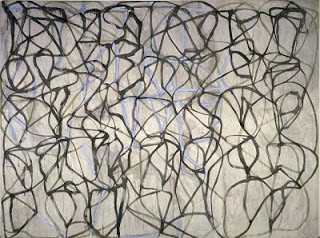
Brice Marden,  Cold Mountain

 Of interest is Brice Marden's encounter with HanShan's poems and Chinese calligraphy. He worked with the ideas and appearance of calligraphy to make a group of works called "Cold Mountain". Though they had little to do with the subject matter of the poems, they are most certainly Zen in the manner of their  becoming.

Fūgai Ekun, another Japanese hermit/monk, made images of Hotei,one of the seven lucky gods of Japan crossing a stream. Hotei carries an empty cloth bag with which he feeds and gifts acquaintances and which is never empty - is he Santa?  How could I not find a philosophy that is funny persuasive?  Didn't hear the Catholics laughing, but maybe I missed it. 


 The next artist, a Buddhist nun, had to move constantly because was hounded by her public and their demands for her work interfered with her ability to make it.  


Ōtagaki Rengetsu, (1791-1875)  "Mountain Crows" 

This is the only photo I was actually able to take because of the gloomy interior of the Pavilion, ostensibly lit as Japanese would light a museum for viewing. 

By this time the zen poetry was writing itself.

My steps were planned for me
sloping ramps
branching pathways
in gray fog gloom.
Peer with aged eyes
at treasure
Always new. 


"Want to know where the cloud way lies?
 It's there, in the center of the void."


Torei Enji
Torei,a student of Hakuin,(1721-1792)wrote The Undying Lamp of Zen.   The Void, Emptiness, was a constant, to be accepted, sought, and not known. 

Then I moved from the Pavilion into the crisp and warm early afternoon sunlight to James Turrell's Ganzfeld (Breathing Light). It's a large empty room up the stairs in which only cinematic projected light is all around the 15 permitted shoeless occupants.  The light ranges from pale tones to deeply saturated hues, none darkened by complements or shaded with black.  If there is a place that is empty yet full, embodying the contradictions of perception, this room is it.


It's a beautiful, unusual experience, easier and cheaper than getting up to see sunrise on Haleakala - you need tickets for that now, too.  The changing light is soothing, slow, slowing down the mind and breathing, marveling at the beauty of LED light.  Manufactured, artificial, mechanically powered, wasteful of energy. But still, unforgettable.

It's a long way to Chartres, and it was a long time ago. The stained glass survived WWII, and it is so blue, like no other blue attained by man's creative hands.

Chartres Cathedral stained glass

Then I scored a cancellation to Light Reignfall - a marvelous body-mind experience rather like an MRI for artists; the only diagnostic result is self-induced. Lying on a cot, my body is rolled into a round bathyscaph.  I chose the "hard" experience this time; last year I'd done the "soft". "Hard reignfall" was/wasn't unpleasant, but demanded, stretched, implored my attention with loud, banging beeps, bracing fast color changes laced with piercing white lights.

I found I was a very diminished person this time around.  The double cataract surgeries I had last year have left me with lots of "floaters", mostly unnoticeable in normal light but which cluttered and glided across my vision cones as I attended to both the Turrell installations.

Glaucoma is genetic and also a complication of diabetes, as is diabetic retinopathy, a deterioration of vision.  If the reality of dialysis and neuropathy aren't enough, the loss of vision is.  An artist will be blind.

Maybe we already are.

When John McLaughlin began his life in art, he said that when he looked at Western art, the artists were telling him who they were. With Eastern art, they were asking him who he was.  Yet he didn't enter a morass of psychoanalytic examination.

"Barrier: to get through it,
follow the pathless path".

He lived in Japan from 1935-1938, studying the culture,ran a Japanese art gallery in Boston, learned Japanese in Hawai'i and served as a translator in World War II.  Self-taught, he was inspired by the monk Sesshū (snow boat) Tōyō (1420-1506), a famous Zen painter fascinated with the concept of the "marvelous void."

He began painting the 1930's and quickly turned to hard-edge geometric minimal abstraction.

He wrote: "With respect to my direct influences I must stress my interest in 15th and 16th century Japanese painters. I have found comfort in some aspects of thought expressed by Malevitch, and I am indebted to Mondrian because his painting strongly indicated that the natural extension of Neo-Plasticism is the totally abstract."[4]  (Wikipedia entry)


John Mc Laughlin late paintings and a Roy McMakin chair - an invitation to the dance.

"My purpose is to achieve the totally abstract. I want to communicate only to the extent that the painting will serve to induce or intensify the viewer's natural desire for contemplation without benefit of a guiding principle. I must therefore free the viewer from the demands or special qualities imposed by the particular by omitting the image (object). This I manage by the use of neutral forms." (Wikipedia entry)


Several artists discuss McLaughlin in a video; to me the seem to muddle around, finding few words to help attend to McLaughlin's work.  "So close to perfect"...he had a really good journey...a rigorous spiritual practice...paintings are about the figure/ground relationship...more organic than mechanical...(Grotjan examining the non-mechanical quality of the edges, lines, and color planes).


Only Venus and Mars
attend this early morning 
Clear in the dawn light.
Look away
And they are gone. 


Thursday, December 8, 2016

Globalism in Art - How to See It, Find It, Is it Possible?


No.  But we can try.  But I'm depending on the art establishment to show it to me.

from the New York Times, 10-30-16, Holland Cotter article

... in the early 1990s, the contemporary-art market fell apart, and some gate-crashing occurred. Artists who were once denied entry, many of them nonwhite, came in. So did new kinds of art, much of it with roots outside Western traditions. An expansive new age of globalist art had begun, and it felt excitingly utopian. By forging links among far-flung people and cultures, art could do what politics could not: bring everyone to a communal table for share-the-wealth feasts, with museums serving as hosts.
In the years since ... globalism as an ideal, in the 1990s sense, faded somewhat from view. The proliferation of international biennials and triennials dulled its edge. The concept had become shopworn from use as a marketing tool. And when globalism became confused with economic globalization, political questions arose: To what extent does sharing dilute difference? Who’s in charge of building that communal table? Who decides the seating?
Recently, globalism, as global consciousness, has come back into focus...

Gloria Steinem Interview KPCC with Alex Cohen

"...female authority is associated with [non leadership qualities]"

 "women are uncorrupted by power"..."Sex and World Peace" book documents how  ...violence against females is the major indicator of an unhealthy dysfunctional society...


"I think we need to look where we are... So if we make every day a day in which we have increased that kind of balance, for instance if we have at least listened as much as we have talked, or talked as much as we have listened and created that balance. If we have looked at the groups around us and said how come this group isn't [as] representative as it should be. If we have made sure there's laughter and music along the way. You know, so I've learned that to agonize and think only about the future is to give up a chance to influence the future by what you're doing right now."
On how to find hope, for those who look at this moment as a time of despair
"I think clearly we need to look laterally at each other and not up at the White House. When we look up, we feel isolated. When we look at each other, we realize that we are the majority— even of the popular vote, that was in Hillary Clinton's favor, and also if you look at public opinion polls of the issues. All the issues that [Donald Trump] opposes, the majority of Americans support. So that is very heartening, and we realize that we have a lot of people power, and there's much that we can do."