Thursday, November 17, 2011

ART: Camille Pissarro

 Pissarro's People: Legion of Honor Museum, San Francisco 

I’ve loved Pissarro very long.   It was an intuitive, pleasant appreciation: a gentle admixture of countryside peace, spatial and formal comfort, and those trees!  Such a reprise of Corot’s silvered beauties.  No wonder I loved him, growing up as I did in Wisconsin, with its rural charm, land and seasonal identity, and the political tides of immigrant democracy that acted upon we small town folk. 
Last year I set out to discover why. In winter 2010, I saw several major Pissarros in San Francisco at the De Young in “Masterpieces from the Musèe d’Orsay”, including the marvelous “Red Roofs in Winter, Village Corner, Impression of Winter”, 1877.  
I love the spatial complexity, the rich softened autumnal palette, the way the tree forms integrate the composition’s structure. The horizontality and slight downward curve of the hill behind the cottages are horizontal, the parallel lines creating a calm quiet mood. 

The paint strokes are thick impasto, laced together and applied with sure, deft strokes. Thus the painting has a vibrant intense quality that provides a counterpoint to the countryside’s still slow nature. Perhaps this is an example of Pissarro’s “romantic Impressionism”, which he left behind as he experimented with other Post-Impressionist styles.  I realize that it is the earlier landscapes that I love the most.

Tuesday, November 15, 2011

FILM: Moneyball

Moneyball, a value-added approach to baseball.

The Oakland A’s have a player payroll dwarfed by the big name teams - the monster Yankees, the benighted Red Sox, but a loyal following.  How did Billy Beane, a player who failed his predictions of stardom, build a fighting team?  By using player stats and creating predictive computer software models to identify under-valued players who could be hired and molded to “beat the stats” and become a winning team. It’s called “sabermetric theory” in the baseball biz.
I remember hearing the same concept when I researched Janus Funds in the 1980’s to begin investing:  their research was so deep and effective they could identify under-valued companies whose worth would increase SOONER rather than later - this was all and good, but we all know what happened to them. 
Billy Beane, as depicted by Aaron Sorkin’s smart script, tackles tough issues - predicting future stars, staggeringly important life decisions, and the value of winning big; are all freshly handled and intelligently realized. 
But it’s not just the “numbers” approach that informs Billy’s strategy.  In the script, Billy reads the decision-making made during a trading session, and hires Peter Brand, a young, awkward advisor, away from his competition, when he realizes that Bren’s nay about the deal was the deciding vote in a clever swap he’s trying to pull. Peter Brand was the only fictional character:  he’s actually Paul DePodesta, now a VP with the Mets, who went to Harvard, not Yale, and is tall and slim.  
 It’s Brand who has the fresh take Billy is looking for, computer modeling, but it’s Billy who dances on pinheads, making seemingly “crazy” ill-advised hiring (and firing) choices, and brilliant trades for under-valued players whose tool-set will fill out a roster and build stats.  I sat there thinking:  would I have the guts and foresight to try something this novel?  Would any of us? It’s truly a depiction of the lone-wolf entrepreneur, a la Steve Jobs.
The film was a fitting bookend to Adam Sternbaugh’s recent NYTimes Magazine article, “The Thrill of Defeat”, (Oct. 23, 2011),  as he writes about the heartbreak of the Boston Red Sox melt-down and other sorrows of the sports fan:  
“And, as with other recent, more consequential once-in-a-lifetime cataclysms, you find yourself not just feeling disappointed or even despairing; you also feel cosmically duped. You question the validity not just of your choices but also of the entire system. And you wonder why on earth you invested such a huge amount of emotional capital in an enterprise that could explode so spectacularly in your face. How could you have left yourself so vulnerable?
But I’m here to tell you that the crushed fans of the Sox and Braves, as well as victims of epic sports collapses everywhere, should embrace, not regret, their ordeal. The epic collapse is to be treasured, even more so than the improbable victory. It’s more rare, and therefore more precious. And it reaffirms the essence of why we root for a team in the first place...
There is... demonstrable value to being a sports fan. It allows you to feel real emotional investment in something that has no actual real-world consequences. In any other contest (presidential campaigns, for example), the outcome can be exhilarating or dispiriting to its followers and, by the way, when we wake up the next day, the course of history has been changed. As for fictional stories, you can certainly get swept up in them, but their outcomes don’t hinge on the unpredictability of real life. Sports stories, on the other hand, are never guaranteed to end happily. In fact, as we’ve seen, some end in a highly unsatisfying way. As a fan, you will feel actual joy or actual pain — this is precisely what non-sports-fans usually ridicule about being a sports fan — in relation to events that really don’t affect your life at all.
In this context, consider the epic collapse. It’s crushing, maddening, unfathomable — and yet it means nothing. Like a shooting-gallery target or bickering sitcom family, your team will spring up again same time next year, essentially unharmed. (Give or take a jettisoned manager or scapegoated G.M.) And so will you...it’s heartbreak with training wheels....leaving you...with some lingering life lesson or other: about resilience, or the eternal promise of renewal”.
But the film, a quasi-docu-drama about a real-life person, deals with the dream-makers, not we vicarious, ultimate FANS.    How do you straddle this gap between sport and life?  Billy Beane’s story tells us: be a romantic faithful lover, a Don Quixote, albeit smart, and play “guts ball” -  make a commitment that is conscious, informed and for real, even though the questions about added and excluded value linger. 


Sunday, August 7, 2011

VACATION: The Sierra Nevada, 2011

South Lake, Bishop Creek Canyon
Begin with a meeting in Bishop with Katharine and Brent, my sister-in-law and her dear friend, a newbie to fishing and the Eastern Sierras, though he lives much of the time on a ranch in the Sierra foothills. Kath lives most of the time in Umbria and Tuscany: each well-traveled folk who declared they’d try trout fishing and someplace fresh. The hublet and I, always ready for a trip to the Sierras, were delighted.   Bishop’s dry heat deceives; the mountains we will drive into tomorrow will be warm, comfortable, and breezy.  
Up early, we’re on the water in a comfortable pontoon boat and practically fool-proof fishing tackle, a catch-and-release technique and lots of smelly power-bait, which rainbow trout love, mostly.  We each caught lovely fish from the southwest end of the lake at the inlet, larger than usual.


Lake Mary, Mammoth Lakes CA

We spent the second day hiking Rock Creek, with its fabulous wildflowers, fishing on Lake Mary, and having a memorable dinner at the Tamarack Lodge on Twin Lakes.  It’s one of our favorite places in the world. What a stunning menu!  We still remember the time Chef Frederick kindly accommodated us by preparing our fresh trout string for late lunch.

View from the White Mountains Methuselah Grove east towards Nevada.

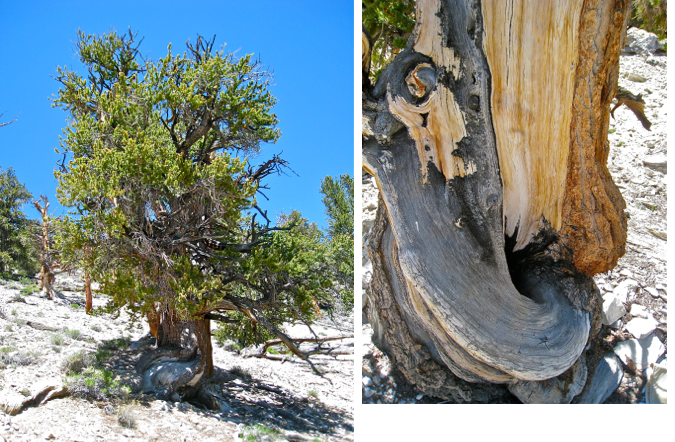
Next day Kath and Brent drove back to the Bay Area through Yosemite, and  John and his fish buddy Gerry, who lives in nearby Independence, went fishing. I drove into the White Mountains to visit the Ancient Bristlecone Pine Forest, a place I’d dreamed of returning to again to hike more fully.
Bristlecone pines are the world’s longest-lived things; some have been carbon-dated to 4,000+ years old.  A 4 mile hike to the Methuselah Grove takes me among these sentinels of time.  They are plentiful, ranged on the mountainside like an army of vigilant angels.


Penstemon and Purple Sage on the trail - flowers in the Whites are somewhat different than in the Sierra Nevada, but were unexpectedly plentiful and surprising to find.


Bristlecone pines survive by dying back and enclosing the old growth within the new.  They grow very slowly, an inch in 100 years, and have few predators.  They survive with adversity, not in spite of it.

A meandering drive on hard gravel at and above timberline led to the less-visited Patriarch Grove, a splendid empty-full landscape, past movements of water and wind richly visible on the mountainsides.


A 5 mile hike in Devil’s Postpile National Monument on the Pacific Crest Trail south was another memorable day.   I saw few people until drawing near to the Postpile campgrounds, and the river was full and rushing.


The Postpile was created when flowing lava was trapped forming a lake.  Later it cooled and cracked in hexagonal columns, one of only 6 places in the world this geological event has occurred

Meadow of shooting stars at Devil’s Postpile Ranger Station meadow.

Our last fishing day we visited Little Virginia Lake, where we ventured out in a rented rowboat - no motors allowed.  As the afternoon moved upon us, the sky changed and we were blessed with some rain, clouds, and later, some thunder and lightning.  It’s quite a sight to see a sierra summer storm with its voluminous inflated cumulus clouds.

The hike was full of wonderful sights, but it would have been worth it if I’d only seen this one: the Sierra’s azure blue butterflies, leisurely “puddling” on the trail.  They didn’t even move when I photographed them, they were so dazed with pleasure drinking water with their feet in the warm sunshine.
Columbine and Elephant’s Ear
It was over too soon.  I got hooked on flowers, butterflies, birds, and hiking once again, by the sunny warmth of Sierra summer, the rush of mountain streams, and placid lakes and gentle days on water, nights of dark sparkling skies, the smell of pines, wind tossing them, the leaves whispering secrets to those who will listen.

Sunday, July 10, 2011

FILM: Cedar Rapids

Candide sells insurance.
Ed Helms, dry wry denizen of “The John Stewart Show”, stars as “man-child” naïf Wisconsin insurance agent Bill Lippe (rhymes with sippy, dippy) sent to the big city for the convention. When we meet him, he’s a needy, nice nerd living a juvenile fantasy by having an affair with his seventh-grade teacher, played by Sigourney Weaver.  Her leave-taking of him is kind, knowing, and very funny – about the only fuzzy moment of this queasy, scowling comedy.

Lippe isn’t even an anti-hero, just a Midwestern rube Candide; his mental condom is a result of loss of his parents at an early age. His appointment with adulthood is set in a city recently flooded by its curving prairie river, value restored by the insurance policies wisely purchased by all (his view of the product he sells so sincerely). He bumbles into reality, reminding me of Tom Hanks state-of-wonder characters, gone a bit awry.

John C. Reilly, his roommate,  “Deansie”, is a braying, boorish, foul-speaking vulgarian with a heart of gold underneath all that cinematically fashionable raunch bleu.  Anne Heche, a delicate redhead, becomes his erotic muse-duenna, ushering him into sexual adulthood and then helping him down easy when the disillusioning crash comes.

Ronald Wilkes (starring in “The Wire”) plays the third roommate – is he the first black man Lippe has ever seen? as a race-neutral nice business guy antithesis of his corrupt Senator role on TV.  The script deftly nods to this character as he “saves” his Musketeers from meth-heads at a party Lippe has stumbled into.

Orin (get it?) Helgesson (Kurtwood Smith) is the hypocritical Babbitt president of the insurance association, sending up and exposing the bullying tactics of the Christian right and the way it buddies up with Horatio Alger/Ayn Rand philosophy.  A brilliant locker room scene that registers Am-I-seeing-this shock –reveals the emperor-has-no-clothes smutch reality as the just-showered Lippe encounters the toga-draped president in the flesh.

Lippe does stand-up right thing at the end of the film: he whistle-blows, rats-out, revealing the bribery and petty payola scheme that was going on.  It’s not such a wonderful life, but that’s what he’s got.   

Does  screenwriter Phil Johnson’s edgy perspective really like this world as much as “Fargo” did? Not for me – an Iowa-born Wisconsin-raised product, I squirmed at being called “corn-fed” living in California – I think it’s a roughly faceted gem of ambivalence that mourns and scorns the possession of innocence in a dirty world.

Saturday, April 9, 2011

ART: Sheila Hicks, Fiber Artist

I've always loved fiber art and weaving, textiles, and texture.  Like Ms. Hicks, I grew up with rag rugs, embroidery, and decorative applications to and on fabric. Fiber is erotic colorful joy ,immediate enrichment of place, and a rich metaphoric resonant carrier for time and memory.


A Career Woven From Life  NYTimes Excerpt
By LESLIE CAMHI  4.3.11
...permutation of string and thread, woven into their potent and intimately beautiful geometries…
minime  (small study) was taking shape, verdant and delicate as a jewel...
The visit’s spirit of open-ended discovery was very much in keeping with the work that Ms. Hicks, 76, has been making for nearly half a century at the intersection of art, design, crafts and architecture. Her resistance to being slotted into any one of these categories has been the natural outgrowth, it seems, of an omnivorous curiosity and a profound allergy to academic distinctions. It may also go some way toward explaining how her work, which ranges in scale from near-miniature to monumental, and at times has anticipated contemporary art practices by decades, has long slipped through the art world’s cracks.
All that is changing now. “Sheila Hicks: 50 Years,” a show organized by the Addison Gallery of American Art in Andover, Mass., and on view at the Institute of Contemporary Art in Philadelphia, highlights the work of this classically trained modernist — a global artist before the term was fashionable — who adopted the language of textiles as her primary medium and expanded it exponentially. Not that her new visibility is making her any easier to pin down.

.
“I have no interest in classifying Sheila as a contemporary artist whom we just ‘missed,’ ” said Jenelle Porter, who organized the Philadelphia show (and is a curator at the Institute of Contemporary Art in Boston). Ms. Hicks, she explained, has always been “very aware of what’s been going on in contemporary art, but she’s also worked with artisans and craftspeople all over the world, and she’s invented new techniques and materials.”
“She goes so much farther than anyone in the design world or the craft world or the art world,” Ms. Porter said. “She crisscrosses back and forth with so much ease.”
Ms. Hicks’s life has been “a tissue of threads woven together on purpose or through chance, fertile encounters,” wrote Monique Lévi-Strauss, a scholar of textiles, in a 1972 catalog. She was born in the small town of Hastings, Neb., in 1934,.. their great-aunts instructed them in music, art and reading, as well as pioneer skills like spinning, sewing and weaving.
She majored in art at Syracuse University, then transferred to the Yale School of Art (then one of the few co-ed divisions at the college), where she studied with Josef Albers, the German-born head of the art department, who had transplanted Bauhaus ideals to New Haven, and with George Kubler, the influential historian of Latin American art. (Ms. Hicks’s fellow students included Eva Hesse, who would also go on to explore unconventional, “soft” materials like latex in her post-minimalist sculpture.) A picture of Peruvian mummy bundles, shown in Dr. Kubler’s class, sparked Ms. Hicks’s interest in textiles, which was further galvanized when Albers took her home to meet his wife, Anni, the celebrated Bauhaus weaver.
A defining moment in Ms. Hicks’ career came with her invitation to exhibit at the Biennial of Tapestry in Lausanne in 1967
“I showed something I had just made in Chile, out of linen, with clusters of long, free-hanging cords suspended from the ceiling,” Ms. Hicks recalled. “At the opening a television crew arrived, led by a certain Madame Cuttoli, a patron of tapestry and a fabulous character. She walked up to me and said in French, ‘Mademoiselle, I hear you are exhibiting a tapestry.’ I replied, ‘Yes, Madame, here it is.’ And she said, ‘I do not see a tapestry.’ ”
“It became a running joke,” …“What is tapestry and what is not? And what should we squelch before it goes too far? I was moving around between different techniques — of stitching, wrapping, braiding, weaving, twining — exploring all these different thread languages. And tapestry was one of them, but traditionally the prestigious one. So my work was equated with a kind of graffiti.”
“For some,” Ms. Hicks continued, “I was persona non grata, and for others I was the heroic pirate. But the architects were coming. I was getting the work.”


Thursday, April 7, 2011

FILM: Lincoln Lawyer

Playing with innocent/guilty - who is, who isn’t reverses itself somewhat surprisingly, while Mickey Haller’s (some pronounce it “Holler”) amoral, yet loyal criminal defense attorney shrewdly returns the compliment when he’s set up by a squeaky clean white guy who really did do it - not just it, them.  Mickey also delivers some satisfying “punishment” to the arrogant murderer who-almost-got-away-with it, with the assistance of two other sympathetic but unsavory clients.  
It’s fun to see a rather flat novel so satisfyingly filled in with characters and the visual grit of LA’s urban freeway-knitted setting.  (Was that a Catherine Opie freeway image on Haller’s wall?)  I had imagined Maggie with reddish hair, while Marisa Tomei, though Italian, conveys a Latino quality -  maybe I’m imagining this.
Now, Hollywood, can you tell me why you can’t manage to bring a Harry Bosch novel to the screen?
REVIEW:  Peter Travers, Rolling Stone, March 8,, 2011:
Confession: I'm addicted to the crime fiction of Michael Connelly, with a bullet next to the page-turners featuring attorney Mickey Haller, defender of desperate scumbags and the occasional lost cause. So why was I hesitant about seeing the movie version of The Lincoln Lawyer, the first of the four Haller novels Connelly has written so far? (The Fifth Witness will be published in April, and it's a corker.) Because Hollywood is infamous for screwing up sure things. Look what they did to James Patterson's Alex Cross mysteries.
OK. Pause. Deep breath. The Lincoln Lawyer onscreen is a slam-bang twister of a legal thriller, full of whiplash energy, tasty acting and — huge credit to director Brad Furman (The Take) and cinematographer Lukas Ettlin — a decadent, scuzzy sense of Los Angeles as a perfect hell for the beautiful and the damned.
Best of all, a dynamite Matthew McConaughey gives his best performance in years as Mick, wearing the character like a second skin. To save money on an office, Mick works out of the back seat of his Lincoln Continental, chauffeured Miss Daisy-style by Earl (Laurence Mason), in lieu of legal fees. Mick has an ex-wife, Maggie (a memorably fierce Marisa Tomei), who works for the DA (Josh Lucas); an eight-year-old daughter he barely sees; and something he tries to hide: a working conscience.
Guilt eats at Mick over a former client (Michael Peña) doing time for a crime that might have involved Louis Roulet (Ryan Phillippe), the realtor stud he is currently defending for attempted rape and murder. Phillippe excels at suggesting the sins that pretty can conceal. There are also juicy turns from the great William H. Macy as Mick's investigator, John Leguizamo as a hustling bail bondsman and Bryan Cranston as a detective who enjoys riding Mick. The Lincoln Lawyer keeps springing surprises. Maybe too many. Screenwriter John Romano (TV's Monk) has the unenviable task of packing Connelly's dense novel into a two-hour movie. Potholes? Yes. Dead ends? No. This is rock-solid entertainment. McConaughey, a cunning mesmerizer in the courtroom, steers this Lincoln into what could be a hell-raising franchise. More, please. Soon.