Friday, June 3, 2016
BOOK REVIEW: The Door, by Magda Szabo; or Good Help is Hard to Find
This book was highly praised by The New York Review of Books. I didn't twinge at the narrative summary - a woman who becomes involved in the life of her housekeeper, but I should have.
Spoiler: My opinion is that of a privileged American woman with littler tolerance for muddled unreasonable individuals.
A narcissistic writer who becomes a literary success needs help managing her household because she doesn't have time to write. Her husband is an oblivious paleolithic male who doesn't seem to think he needs to help her. She doesn't think there's anything wrong with this picture.
She hires a highly recommended housekeeper but allows her to set her own hours, and choose her own tasks and menus. Personal boundaries break down between the woman and her housekeeper and she quickly becomes an obnoxious tyrant. The writer allows herself to be trampled by cruel judgments, harsh criticisms, and outrageous relations, I guess because she's spoiled by the high quality service and food (when she gets it), and feels guilty because of class distinctions.
The writer discovers how tragic events damaged her good and faithful servant; the Holocaust and the Hungarian uprising make grievous wounds. Housekeeper has made her victimhood into self-tyranny and primitive obdurance, inflicted upon everyone else.
In the end, the housekeeper's own home is dirty and hoarded full of junk, and whatever valuable furniture she was going to receive from the housekeeper is found to be full of worms and worth nothing.
The keeper from this: some people construct unassailable protected defense mechanisms that are so filled with anger they can't be saved. Even protecting them from themselves is impossible. So this is news? To whom?

PAINTING: Agnes Martin, LACMA

Oh, dear. Sometimes I think I love the philosophy, intentions, and writings of Minimalist abstract expressionists more than I love the actual artworks.
That said, I love Agnes Martin's work - all of it. She seems to be to be the perfect pure artist, refined, filled with joyful and kind intention and attention, empty of self, transcended and suspended in the moment, in the world yet fully in spirit, a true vector for glimpsing the Tao, and accepting the self and its limits, as Freud concluded we must.
Looking at her work is like always being able to hear the distant and poignant whistle of the train.

In this photo, so stoic, present, and resolved, gazing with full knowingness, and the quality of borne pain it carries - Agnes Martin reminds me so much of photographs of my grandparents and great-grandparents from the late 1800's and early 1900's - German farmers tough of spirit, dour, and almost sullen as the face the camera. Of course, they didn't smile because they had to hold still for so long to expose the film, right?
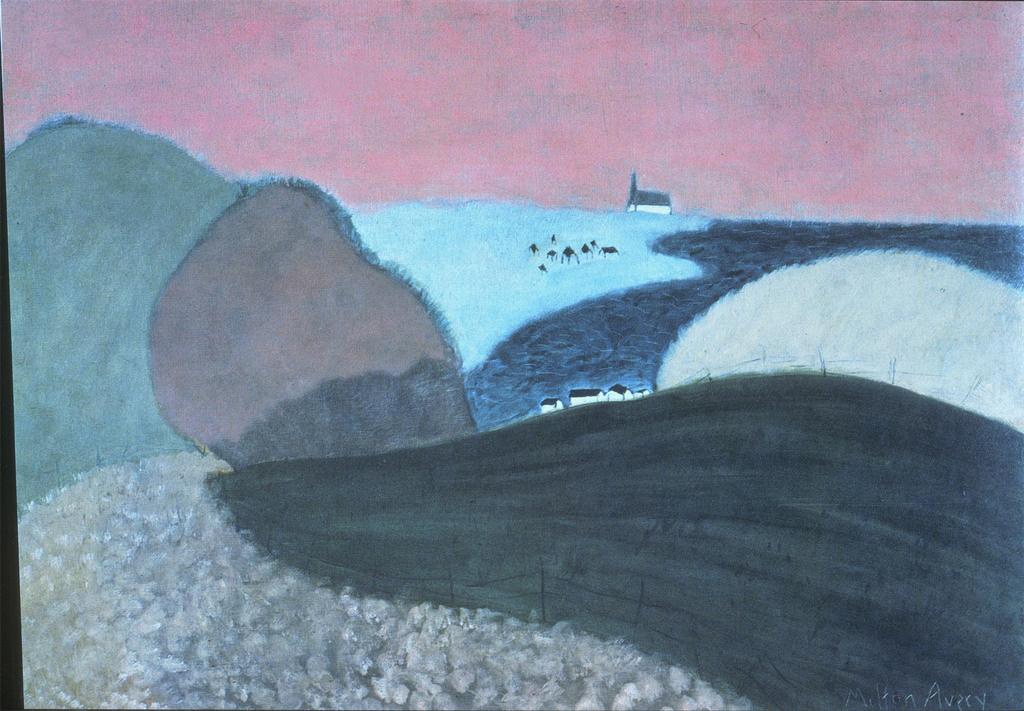
So what and who does she make me yearn for? For Martin Avery, for Mark Rothko, for Sean Scully.
That said, I love Agnes Martin's work - all of it. She seems to be to be the perfect pure artist, refined, filled with joyful and kind intention and attention, empty of self, transcended and suspended in the moment, in the world yet fully in spirit, a true vector for glimpsing the Tao, and accepting the self and its limits, as Freud concluded we must.
Looking at her work is like always being able to hear the distant and poignant whistle of the train.
In this photo, so stoic, present, and resolved, gazing with full knowingness, and the quality of borne pain it carries - Agnes Martin reminds me so much of photographs of my grandparents and great-grandparents from the late 1800's and early 1900's - German farmers tough of spirit, dour, and almost sullen as the face the camera. Of course, they didn't smile because they had to hold still for so long to expose the film, right?
So what and who does she make me yearn for? For Martin Avery, for Mark Rothko, for Sean Scully.
 |
| Midwinter, 1954 |
 |
| Untitled, 1959 |
 |
| Untitled, 1960 |
No one talks or writes much about whether Martin's diagnosed schizophrenia shaped her art, how, and how much. As I look at the body of work, I think I feel the grid as a cage, a prison always settled over her being in which she worked ceaselessly with as much precision as she could bring to bear to explore the possibilities of her constrained existence.
Of course, that's what we've all got, right? The ultimate non-knowing subjective state of what we can know and not know we don't know; the physical constraints of perception, the body and time which construct that grid..
Of course, that's what we've all got, right? The ultimate non-knowing subjective state of what we can know and not know we don't know; the physical constraints of perception, the body and time which construct that grid..
 |
| The Islands, 1961 |
How satisfying, now beautiful, how right.
 |
| Summer, 1963 |
 |
| Friendship, 1963 paper |
 |
| The Egg, 1963 ink on paper |
 |
| Untitled, 1995 oil on canvas, 6"x6' |
 |
| I Love the Whole World, 1999
I leave Martin for a time, with the gate open, and go to Rothko and Avery to be underwater, submerged in color, to dissolve the grid, to loosen, ungrid, unravel; to move with liquid freedom in warm ocean waters, floating, always floating through time and space, untethered, called back only by breath.
 |
 |
| Mark Rothko |
 |
| Sean Scully, Home |
ART: Grazing the Internet, Edward Kienholz, Rachel Whiteread

Rachel Whiteread's artwork, "Cabin", is being installed on Governor's Island in New York City. It's a reverse concrete cast of a small outlying building. Looks so marvelous with the sophisticated architecture behind it, a ghost-dwelling for those who seek America first spiritually and then in body.

 |
| 5 Car Stud, 1969-1972, Edward Kienzholz |
The effect Kienholz' installations had on me when I was in my 40's was ultimately political, didactic, pandemic agreement. I was an art equivalent of a demagogue - familiar refrain these day, yes? - ranting at injustice. Look, see what misery, horror, loneliness, suffering, injustice really looks like? Stop it now! Make it stop!
In my 70's now, it seems that a much less egotistical narcissistic reaction occurs. It's quiet, grieving: a perspective sees that the earth constricted in spatial and temporal bands of suffering and injustice that can never be forgotten - not one death redeemed, all lost. It must be pushed until death, another level of Sisiphys-ian existence.

PAINTING: Emily Carr, seminal Canadian ethnographer and painter


Rhine Maidens'
far-away echo,
grieving the
inevitable rape
of our earthly
home.
I learned about Emily Carr when I was exploring the Canadian landscape painters called "The Group of Seven".
She documented the Native American tribal cultures of Canada, frequently painting their totems and other craftwork. A current exhibit at the Art Gallery of Greater Victoria documents her life, work, and influence on the next generation of artists.
Steve Martin recently curated an exhibition at the Hammer on Lawren Harris, which focussed attention on this fascinating art group. Their work is dynamic, lyrical, celebratory; images of American landscape unplundered, unspoiled by fracking and gas pipelines.
 |
| secret fracking dumping operation disposing of waste fluids in Canada |
The Group of Seven, also known as the Algonquin School, was a group of Canadian landscape painters from 1920 to 1933, originally consisting of Franklin Carmichael (1890–1945), Lawren Harris(1885–1970), A. Y. Jackson (1882–1974), Frank Johnston (1888–1949), Arthur Lismer (1885–1969), J. E. H. MacDonald (1873–1932), and Frederick Varley (1881–1969). Later, A. J. Casson (1898–1992) was invited to join in 1926; Edwin Holgate (1892–1977) became a member in 1930; and LeMoine FitzGerald (1890–1956) joined in 1932.
Two artists commonly associated with the group are Tom Thomson (1877–1917) and Emily Carr(1871–1945). Although he died before its official formation, Thomson had a significant influence on the group. In his essay "The Story of the Group of Seven", Harris wrote that Thomson was "a part of the movement before we pinned a label on it"; Thomson's paintings The West Wind and The Jack Pine are two of the group's most iconic pieces.[1] Emily Carr was also closely associated with the Group of Seven, though was never an official member.
Believing that a distinct Canadian art could be developed through direct contact with nature,[2] the Group of Seven is best known for its paintings inspired by the Canadian landscape, and initiated the first major Canadian national art movement.[3] The Group was succeeded by the Canadian Group of Painters in the 1933, which included members from the Beaver Hall Group who had a history of showing with the Group of Seven internationally.[4][5] (from Wikipedia).
Another artist I include in this genre is Rockwell Kent, an unusual
illustrator and painter who lived in Alaska and Greenland,
an Ayn Rand caricature well known for marvelous illustrations for an
edition of "Moby Dick". His work is reductive, frozen,
filled with germanic, gothic Wagnerian grandeur.

Wednesday, May 18, 2016
AUTRY MUSEUM OF WESTERN ART: Gardena High School Collection, Permanent Works,

 |
| Rick Bartow, "Crow", gouache on paper |
The Gardena High School Collection
California Impressionism: The Gardena High School Collection features a selection of nine paintings from the collection, including major works by notable artists such as Maynard Dixon, Jean Mannheim, and Edgar Payne. The paintings on view reflect the state’s scenic diversity as well as the vitality of Gardena High School’s program and the Impressionist movement that once flourished here.
 |
| Franz Bischoff, "A Cool Drifting Fog", 1924 |
 |
| Edgar Payne Rockbound, circa 1918 |
 |
| Jack Wilkinson Smith, "Lingering Snows", undated |
 |
John Frost, "Desert Twilight", 1924
Checking on line on the Gardena High school website, I learned that the collection has about 100 paintings in it, all in storage, none on display because they have no gallery. Fundraising continues but I'm not optimistic this will amount to much. I hope LAUSD is helping them with conservation and storage. This collection is too important to leave unviewed by district's children and by the public. I'm thinking about doing something about it - what would that look like?
The Permanent Collection
|
 |
Albert Bierstadt, "Landscape with Indians", 1859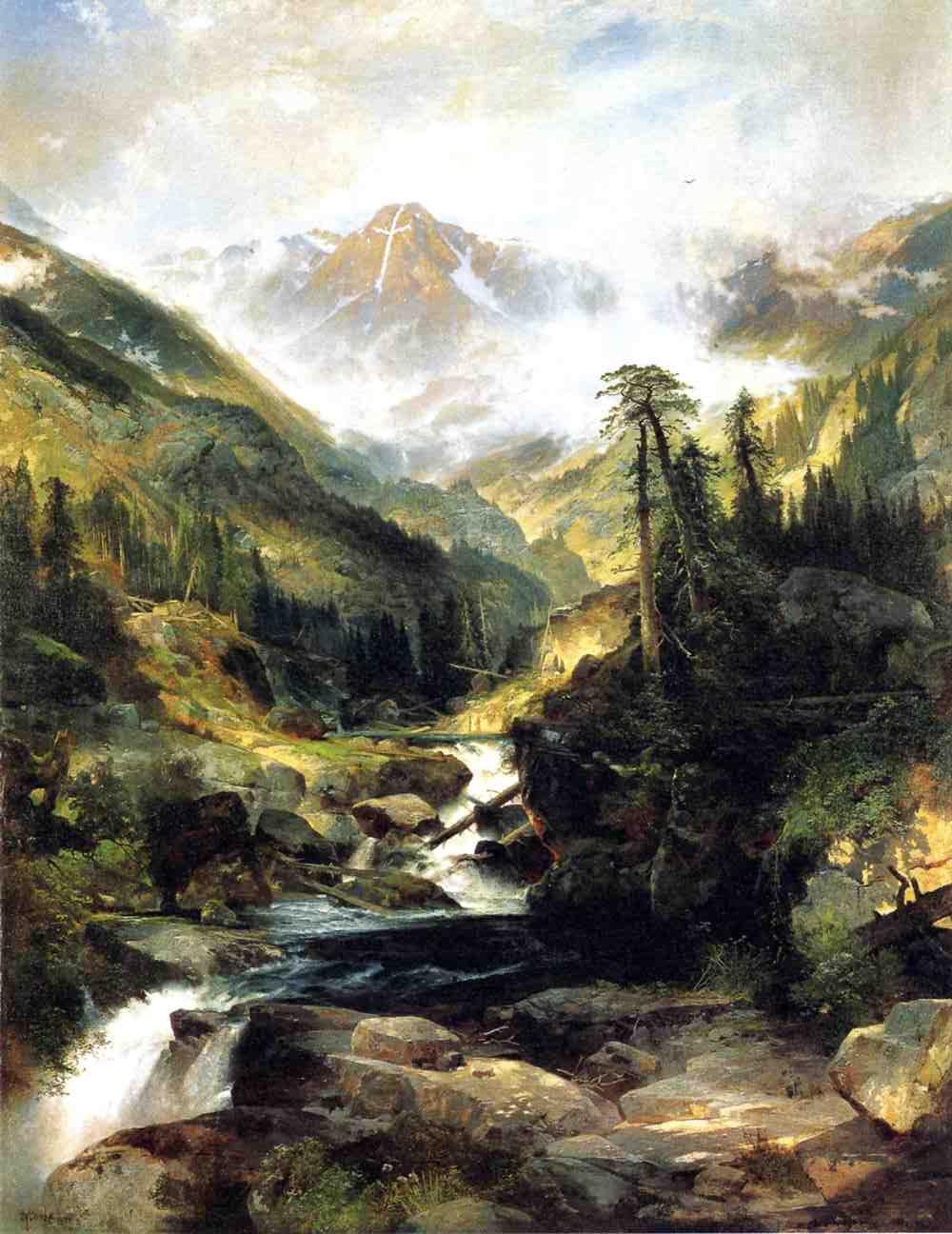 Thomas Moran, "Mountain of the Holy Cross", 1875 Gene Autry Lunchbox, 1950's  |
Saturday, May 14, 2016
BIRDING & FLOWERS: Franklin Canyon Reservoir, Santa Placerita Canyon Park, Newhall
Plentiful at Franklin Canyon:
Seen at both places - a charming little energetic gray bird with its crest. Hopped onto our picnic table to pick up a sunflower seed someone had left there.
 |
| orange sticky monkeyflower - Franklin Canyon |
 |
| oak titmouse |
Seen at both places - a charming little energetic gray bird with its crest. Hopped onto our picnic table to pick up a sunflower seed someone had left there.
 |
| Calochortus clavatus var. gracilis; Slender Mariposa Lily Seen trailside at Placenta Canyon. A local unusual variety of Mariposa Lily/Tulip. My most scientific field guide, by Niehaus, lists neither of these flowers. |
 |
| turtles sunning - Franklin Canyon Reservoir |
My brother who lives in Iowa came to stay for a week to recover from wrist surgery. He tends to the acerbic when contemplating LA lifestyles - traffic, home values, big city indifference, all quite valid, yes?
I wanted to take him to see an "urban greenspot", so we started out for Franklin Canyon. Of course, another LA water main had broken and a detour was necessary. And the popular park was that day a site for a movie shoot. The little pond was going to be filled with kayaks and inflatables. Loud conversations concerning setups, placement, floated over to us as we circled the small lake, as we sat and listened to the peculiar comforting sound of ducks as they strained water through their beaks for food (combination of a gurgle and suck).
This he found to be of interest, to my relief, and once away from the large pond, well known as the lake where Andy Griffith went fishing in the TV show's title sequence, we found a picnic spot under the oaks to relax and watch ducks, turtles, and a few birds. Marvelous sunny weather with a slight breeze and moderate temperature.
Next day up early to drive to Newhall for another bird walk. It was Open House at the Nature Center, and after the walk we strolled about chatting with exhibitors, enjoying displays of natural history.
Best bird seen at Placerita - male Western bluebird. Placenta Canyon has a lovely stream (winter/spring water only). There's a cabin actually used by the Walker family. I want to live in it in summer. Sorry, display only. Visitors could try washing clothes on a hand-operated wringer washing machine, with a scrub board, and sawing logs with an ancient two-man saw. Really comical.
The docents/volunteer group was impressive, and the community turnout so large shuttle buses ran the crowds. Glad we got there early.
I wanted to take him to see an "urban greenspot", so we started out for Franklin Canyon. Of course, another LA water main had broken and a detour was necessary. And the popular park was that day a site for a movie shoot. The little pond was going to be filled with kayaks and inflatables. Loud conversations concerning setups, placement, floated over to us as we circled the small lake, as we sat and listened to the peculiar comforting sound of ducks as they strained water through their beaks for food (combination of a gurgle and suck).
This he found to be of interest, to my relief, and once away from the large pond, well known as the lake where Andy Griffith went fishing in the TV show's title sequence, we found a picnic spot under the oaks to relax and watch ducks, turtles, and a few birds. Marvelous sunny weather with a slight breeze and moderate temperature.
Next day up early to drive to Newhall for another bird walk. It was Open House at the Nature Center, and after the walk we strolled about chatting with exhibitors, enjoying displays of natural history.
 |
| matalija poppy |
 |
| woolly blue curls-rosemary like leaves |
 |
| interior, Walker cabin |
The docents/volunteer group was impressive, and the community turnout so large shuttle buses ran the crowds. Glad we got there early.
Wednesday, May 11, 2016
ART: Lucy Jones, Susanne Rubin, Frederick Gore

 |
| Frederick Gore, Country House - English watercolorist |

Lucy Jones, English artist - what astonishing color and energy.


 |
| Robert Clunie - Saginaw, or River Dwellers |
Subscribe to:
Posts (Atom)