Monday, February 20, 2017

Painter Joan Eardley - Selected works of landscape

Another lovely painter discovered from art digest websites.  I will probably never see these artists' works but I fall in love at least weekly with an artist I find while I wander virtual beauty.

Catherine in Winter 1961

Winter Fields, Catherine


The Wave

Friday, February 10, 2017

Susan Rothenberg - Late Paintings

I have followed Susan Rothenberg since I saw her famous paintings of horses years ago. The animals seem imbued with distinctive spiritual energy, bursting, filling, almost departing the canvas surfaces that contain them.

Bubbles Yellow
Her ability to paint abstractly while retaining some figuration has always seemed masterful and confident.  Impasto techniques give an opaque yet rich depth to the canvas. The beings are sentient, the forms having a strange awkwardness. I was struck by the same  asymmetric character in the portraits of Alice Neel. The dog's limbs, joints, and contours connect stiffly to the body core.   Yellow Bubble's eyes ask the eternal question: "When are we going for a walk?" 
Dog with Green Head

This dog's gaze is watchful, watchful, almost calculating whether to even request one.

The green head is among the features of the work that make me smile. Matisse painted his wife with a green stripe down her face, shocking French art critics. (They did set themselves up for that, n'est pas?)

The 3 bird paintings recall to me Morris Graves. His paintings of birds, made after World War II, haunt me. 
With their gaunt,aloof presence, they are affected with an isolation and desolation of soul, like looking at photos of emaciated Holocaust survivors. The painted birds seem to have transparent permeable bodies, despite the surface opacity of their materials.


Red Bird
Rothenberg's birds are not bereft creatures, though.
Red Bird broods, back turned towards us, hunched shoulders cradle its bowed head, the dance is finished, and the bird accepts quiet applause.

Look at the colors! The possibilities when using impasto,loose brushstrokes are as compelling as any Old Master secret glaze recipe. These late paintings are so freed in their use of color, sure in the harmonies.    

Pink Raven
The figure/ground relationships mostly remain delineated. Rothenberg seems to have gracefully passed through the needle of "push-pull" 
abstract spatial dynamic theory. Her compositions are pared and simple, but depend on a positive-negative spatial component. Even so, edges  are roughened, overlaid, and blurred, sometimes to the point of partially obscuring the forms, as in 3 Monkeys.
3 Monkeys
The monkeys seem set in plaster, like fossil displays, or emerging from a thick scrim of snow and obfuscation. It's one easy stride to metaphor; the gunk of fundamentalist explanations. I cannot help but think of the 3 wise monkeys admonishing us about conducting ourselves surrounded by evil.

Indigo

The darkness is waiting, more beautiful, seductive, and dangerous than any Disney or del Toro maleficent creature.  This dark bird has power, while Graves' creatures are bereft of all but poignant waning sentience.      
The Caribbean
Rothenberg does not neglect blues. I have been to the tropics many times, and of all the beauty in the world, surpassing even the sunset, tropic blues "zen" me without any koan-type struggles. If this is the void,  subjectivity, I'll float awhile, drown if need be, just to stay in the moment of yielding, the joy of entering warm ocean waters of incomparable splendor. 

But Rothenberg's two swimmers, perhaps illuminated by the resort's spotlights, seem to be lifted by a rising wave, its crest dark behind them. They are languid, suspended, given over. Will they be caught as it breaks, or slide easily down the back? 

And for all the narrative material, the paintings are more important stylistically.  I think Susan Rothenberg has unified form and content, and that is an accomplishment
finally depending on formal painterly means, making for art, not illustration.   

Ineffable Magritte - does the Tao exist?

(these notes are based on an article in the web journal AEON) 
ineffable - too great to be described in words
Add captionRené Magritte, Variante de la tristesse (Variation of sadness), 1957. Oil on canvas, 50 x 60 cm. Kerry Stokes Collection, Perth. Photo: Acorn Photo, Perth. © VG Bild-Kunst, Bonn 2017.


Magritte (1898–1967) was a conjurer of enigmatic paintings. He did not see himself as an artist, but rather as a thinking human being who conveyed his thoughts through his painting. Throughout his life he sought to imbue painting with meaning equal to that of language. Driven by his curiosity and his affinities with some of the leading philosophers of his age, such as Michael Foucault, he created a remarkable body of work and developed an altered view of the world that is reflected in a unique combination of masterfully precise painting and conceptual processes.   - from the website Eflux, arts and ideas digest

I thought ineffable meant beyond words, a sealed, unknowable meta-reality.  All that can be explained about what is ineffable is a definition of non-knowable, to conceive that we do not know or cannot access the knowledge within.

But if language can discern or conceive something ineffable, then why cannot language explain what the content is?

Because language can conceive of paradox.
Ineffability is a conception and an example of a paradox.

What it isn't, is the inability of the speaker to describe or explain an experience  because of the limits of that individual's education or vocabulary, or unwillingness to attempt to, or his inadequacy to do so.

The idea took hold that ineffability is a symptom of the insufficiency of language to capture the ultimate truths of the world.

...the notion of ineffable truths relies on the notion of subjective facts, we should also give up the notion of ineffable truths

What may be ineffable, or inexplicable, is phenomenal experience - the experiences of the body, the physical, of color, of playing a violin.  

What is mysterious to me:

•the origin of the universe
•the issue of whether animals and plants are   sentient beings 
•why I am alive
•how the brain convinces us we are self conscious beings 
•what is the nature of subjectivity
• how conceptualize the magnitude of the universe


Sunday, January 22, 2017

Painters Louise Belcourt and Justin Margitich and abstracted landscapes

To Be:  Liminal -- how to arrive at this delicate place?
.
"...the liminal spaces of perception"    

What does "liminal" mean?  I thought it has to do with light, illumination that provides perspective. Something elevated, spiritually pure, rational, intentional, unlike its scary opposite, subliminal, with its 50's brainwashing reverb, its paralysis of analytic insight.
Liminal, it turns out, is actually simpler:  

liminal |ˈlimənl| adjective technical 1 relating to a transitional or initial stage of a process.2 occupying a position at, or on both sides of, a boundary or threshold. (New Oxford American Dictionary)
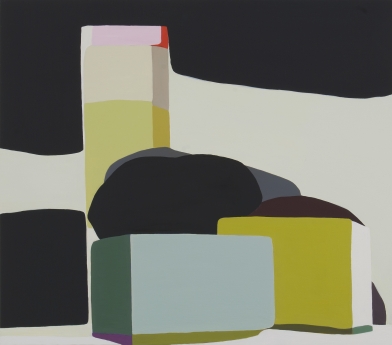
Louise Belcourt Locks Gallery Painting Mound #18
Louise Belcourt, Mound #8, 2015
The word was used about the work of Louise Belcourt, a Canadian artist who lives in urban Brooklyn and rural Canada.  I immediately loved her paintings.  They are easy.  I love her colors. Oh, that pea-soup army green, the delicate lavender, the blackish voids!  They are colors of haute couture fashion, perhaps found on scarves, textiles, or area carpets placed in cool Manhattan high rises.


Lamb's Ear #5, 2016
Blocky shapes pile upwards from the horizon line at the bottom edge of each canvas and coalesce into abstracted vistas. Belcourt utilizes an organic approach to perspective and sophisticated shifts in color to render depth, space, and atmospheric light. The liminal spaces between the tightly packed fields of flatly applied color function as alleyways from foreground to middleground. ... I recognized the images as completely imagined places assembled using the language of landscape painting, rather than relating to the real world around us. (from website artblog: Imaginary Vistas-Louise Belcourt at Locks Gallery)

Belcourt’s paintings explore the intersections between the built and natural world. For her first show at Locks, the artist presents new oil paintings of architectural “mounds” in shifting spatial planes—what she calls “paintings of sculptures of landscapes... her paintings, which blend impressions of the countryside and crisp Canadian light with city rhythms and the blocky architecture of New York City. Belcourt’s imagery evokes forms from prehistoric “mound-builders” to urbanization, while creating a visual language distinct from a purely representational or abstract syntax. ..Using bold colors, radiant light, and dynamic perspectives, Belcourt’s images of tectonic landforms—stacked, occluded, and cascading into foreground and background—meld nature and man-made forms, reflecting an ecological awareness and heightened sensitivity to the world around usJuThe artist employs a directness, physicality, and visual clarity in her paintings that feels increasingly rare in our media-driven digital age. (from Locke Gallery website).

The writer comments that, despite the contemporary palette, the paintings have no references to digital culture.  The painter and the paintings act as visual mediator, cleared of digital processing. 

I guess that makes her a romantic, and possibly irrelevant to contemporary art. I think she's moving wonderfully in the formal issues of painted abstraction, still grounded in earthly splendor.  

We could go for a walk in her paintings, the forms of nature reduced to mounds, meanders, and structures that shift the relation between self and world, like entering a well-proportioned home.   

In painter Justin Margitich's new show, "A New Sublime" at Moskowitz Bayse, the artist seems to embrace digital forms, according to the gallery commentary.  In the painting below, fluid ribbons struggle to escape the clinch of empty and connected "frames",  (television screens, film frames?)     


 Justin Margitich  Iridium #3 , 2014 Acrylic and colored pencil on paper 24 x 24 inches  

Justin Margitich
Iridium #3, 2014
Acrylic and colored pencil on paper
24 x 24 inches
 Pieces on panel painted with acrylic, heightened with graphite, express brightly hued linear gradients that both expand and contract in space; works on paper mounted to panel echo the wildly colorful line work, while adding the complexity of organically fluid forms. Across media, the artist’s compositions make use of a world of color that goes far beyond secondary and tertiary while simultaneously resisting muddiness, creating a near impossible balance. Together these paintings present a series of spaces unseen; bizarre and foreign vistas of arcane forms that resonate at once as eerily familiar and strikingly unknowable.
Justin Margitich meditates deeply on natural forms in a digital world. His paintings distill and fracture landscape, creating a formal language that challenges common perception of perspective and logical space. Margitich reconciles vanishing notions of idyllic landscape with our growing reliance on digital technology in a cohesive aesthetic act, creating a new sublime image. (from Moskowitz Bayse website)
 Justin Margitich  Variations 15 , 2016 Acrylic, watercolor and paper on panel 30 x 22 inches  
Justin Margitich
Variations 15, 2016
Acrylic, watercolor and paper on panel
30 x 22 inches
In "Variations 15", two ovoid globes just begin to touch, the frisson seems to blacken and burn, overlaying the radiant content, like a piece of film burning.

 Justin Margitich  Derivation 3 , 2016 Acrylic and graphite on panel 36 x 36 inches  
Justin Margitich
Derivation 3, 2016
Acrylic and graphite on panel
36 x 36 inches


"Derivation #3" references light shafts, fractals, or perhaps rockets taking off? Shapes are juxtaposed, overlaid, interwoven. I mistrust myself when I  find such narrative material in painting.  I cringe because I think of all the artists I've heard explain that there's no there there.

And as Steven Alexander explains: discerning meaning in a painting is not the same as reading a narrative. To regard a painting simply as a text is to ignore the extreme complexity and the mystery of non-sequential interactions that take place in the inclusive realm of aesthetic experience. (from his blog post, 5-18-08, "Meaning and Abstract Painting")

Just the casual viewer puzzling through his abstraction encounter, making a guessing game out of enigmatic figure/ground relations.  Not that it's the painter's fault, it seems more a failure of my own perception here. 

Margitich's agenda is formidable - to explore the digital sublime, and resolve it in painting. To me, his paintings remain cool and aloof,incomplete passes at a goal worthy of further attempts. 


Sunday, December 11, 2016

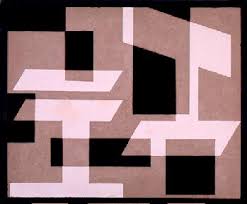
John McLaughlin: Hard Edge, Minimalist Abstract Painter


A new exhibit of this artist's work at LACMA, as revealing and compelling as was the Agnes Martin retrospective.  John McLaughlin is another artist summoned to Eastern philosophy, yet convinced that with Western geometries it was possible to convey the astringency, reductive simplicity, and stillness of Zen.  


1946, Norton Simon Museum


I have not identified every image in this posting. Almost all of them are my own photos, arranged chronologically, and since most have no titles, I simply want to look at them and enjoy the progression, variation, and direction which McLaughlin expresses in his painterly journey to the void.


1947


He lived in Japan from 1935-1938, studying the culture,ran a Japanese art gallery in Boston, learned Japanese in Hawai'i and served as a translator in World War II.  Self-taught, he was inspired by the monk Sesshū (snow boat) Tōyō (1420-1506), a famous Zen painter fascinated with the concept of the "marvelous void."

He began painting the 1930's and quickly turned to hard-edge geometric minimal abstraction.

He wrote: "With respect to my direct influences I must stress my interest in 15th and 16th century Japanese painters. I have found comfort in some aspects of thought expressed by Malevitch, and I am indebted to Mondrian because his painting strongly indicated that the natural extension of Neo-Plasticism is the totally abstract."[4]  (Wikipedia entry)
1948


When John McLaughlin began his life in art, he said that when he looked at Western art, the artists were telling him who they were. With Eastern art, they were asking him who he was.  Yet he didn't enter a morass of psychoanalytic examination.

"Barrier: to get through it,
follow the pathless path".


"My purpose is to achieve the totally abstract. I want to communicate only to the extent that the painting will serve to induce or intensify the viewer's natural desire for contemplation without benefit of a guiding principle. I must therefore free the viewer from the demands or special qualities imposed by the particular by omitting the image (object). This I manage by the use of neutral forms." (Wikipedia entry)


Several artists discuss McLaughlin in a video; to me the seem to muddle around, finding few words to help attend to McLaughlin's work.  "So close to perfect"...he had a really good journey...a rigorous spiritual practice...paintings are about the figure/ground relationship...more organic than mechanical...(Grotjan examining the non-mechanical quality of the edges, lines, and color planes).


The lovely chairs placed in perfect relation to the paintings were crafted by Roy McMakin, and each is slightly different, and merit another walk through the rooms to view them and the paintings in relation.  And how very pleasing it is to do this. Discovering how each differs and how the quality of this difference refers and is generated by each painting is purely fun, and nodding, of course, this is just right, perfect, at each one.