Thursday, October 25, 2012

FILM: "The Master"


Post World War II void and trauma and its re-alienated individuals ironically spawn cults of belief in charismatic hucksters. Quell (quell my pain), on the run, stows away on a boat and is adopted by The Master, who manipulates him with degrading and mindless exercises while encouraging him to brew his potent, potentially lethal, alcohol concoctions.

I struggled to match my attention to the slow narrative pace, my need for resolution conflicted with my dread about what painful incident would follow next. Editing here skillfully serves the contrasts of character and story. The power struggle between Quell and Dodd remains unresolved by any cathartic event. So those of us who like a car chase or an explosion to create epiphany face a dilemma of plot structure: flawed and tedious or serially nuanced exposition?

Who is master, who is slave? Quell and Dodd are bound homo-erotically, but more completely by their twinned natures (Quell brutish, Dodd magnetized slime), driven by an omnivorous thwarted sexuality which provides the corrupted life energy driving each. The Master and the servant masturbate, go to jail, and lose emotional control in parallel experiences that reveal their cloven natures. Quell achieves a kind of existential freedom when he is expelled and leaves The Master. He continues his sexual questing and alcoholism, we conclude, a drifter until the downward spiral ends. In their quasi heroic and defiant choices, each is becomes nullified and banal.

The film has a fine score (though somewhat post-modern in feel), and beautiful production values, filmed in 70-mm, and lovely cinematography and editing. Would that all films attended to the formal elements of film to deepen the film experience’s visual potential.

Philip Seymour Hoffman has a voice that would seduce the most devoted celibate, and his portrayal of The Master as a kind of uber-Dyonisian-male satyr (the dance scene) is powerful. Joachin Phoenix’s Quell contorts his body into a kind of German expressionist crucifixion carving, hands nearly always placed on the hips, yet twisted in reverse, forcing shoulders forward and shaping his chest into a concave void. In one scene he is required not to blink for an extended time while being “processed” - an excruciating minor torture. (Try it during the scene, and you’ll see what I mean.)

Amy Adams plays his chillingly true believer wife, revealed as a kind of implanted Master in Dodd’s consciousness, and Laura Dern is a swindled cult member. I won’t forget the puzzled look on her face, and despite the lack of comprehension, acceptance of the Master’s word, when she challenges him about a revision of The Inquiry/Process in his second book.

The director, Paul Thomas Anderson, (Boogie Nights, Magnolia, There Will be Blood) is an important contemporary filmmaker, and should be attended to. I leave it to you to declare, “pretentious and boring”, reminding you that I’ve heard that one a lot, and it’s usually coming from those “car crash” enthusiasts I mentioned earlier. Seriously, the problem is art that requires a willed attention: a choice to stay open to the artist’s intention, and a lack of expectation that escapist fantasy will be deeply satisfied. You’re on your own - submitting to the experience but with awareness. Try it sometime.

ART: MOCA Exhibit, World Post-War Abstract Painting

Destroy the Picture: Painting the Void, 1945-1962, MOCA Exhibition - Raging at the Dead Light, the Dark Night

The work in this exhibition is noteworthy for its pioneering use of materials and processes, and the magnitude of its screaming expressive pain.  Paul Schimmel’s last curated exhibit for MOCA before resigning due to conflicts with the new director, Jeffrey Deitch - “contemporary art lite” vs. serious-scholarship approach. So you want to see it for that reason too.  Where’s Schimmel going to go?
 Some of the artists are familiar: Jean Fautrier, Lee Bontecou,  Alberto Burri.  It’s a selected comparative world survey of modern painters who responded to the tragedy of World War II by hacking, burning, cutting, smearing, excavating, rejecting imagery.  The works look vital, angry, direct, shocking:  poignant efforts to heal the broken faith between nation,  citizen, and self.
Lee Bonecue, Alfredo Burri
How could one go on, after the ghastly brutality and horror of world war, nuclear destruction, and monstrous genocide?  Gutai, (“embodiment/making with the/of the body’) the Japanese post-war movement, was particularly painful to view. 


Kazuo Shiraga, painting with his feet
The countries I love for their astonishing aesthetic accomplishments:  France, Italy, Japan - all enemies during World War II.  My memory is longer than it should be. And now they have the ability to transmit their empty souls to me, even though they are at primary fault for that terrible war.  Humanity would not have come to this if real democracy had prevailed.  Alas, only stupidity ruled those days.  Not like today at all, n’est ce-pas?

But it’s all very obvious and familiar, brutal in its own way, as if the painters’ hands and brains had become intellectual stumps, making the art of amputees smearing and raging at a dead light, the dark night.  And the work is still somehow seductively beautiful; that’s what so wrong and disturbing.  This reality makes the work even more powerfully subversive, corrosive, denying and creating a subtle reality about the actual nature of evil.  
Here’s the thing - I don’t think this artistic direction develops much beyond the body/skin/canvas metaphor which depicts its torture and degradation, in a sort of ghastly decorative way.  And then it’s done.  No place else to go.  You can only destroy everything there is to destroy, after all.  
At MOCA you can walk across the lobby after seeing this disturbing group of artworks and sit quietly and mostly alone with eight Mark Rothkos, more of them together than you can find at the Met or MOMA.  They will take you in the other direction:  the Abstract Color Field painting movement, a seeking of spiritual release and transcendence, another kind of loss of self that is an understandable response to war.  
In these works the artist assumes you already Got It; you don’t need assistance to plumb the  dimensions of atrocity.  But you need to go on, to find a way to do that, some neutralizing calm, from which you harvest a release forward.
And one is given beauty in a new formal manner, an innovation that seems a culmination of the intent and direction of the painting movement known as abstraction.  
But I can’t help returning to now, and to Gerhard Richter’ squeegee paintings. A step back, but the only redemptive work from the warrior countries that I find.


The work to the right above is titled “Uncle Rudi”, a photo he painted of his actual relative in his Nazi uniform.  Not hard to for me to imagine the wiping over of his canvas is his wiping out of his history, his memory, his shame, a kind of burial and green graveyard.

Thursday, October 18, 2012

BOOK: Kishar Desai, "Witness the Night"

Sometimes I wish I wasn't fascinated by the "who did it?" narratives of crime novels. Along the way, lots of blood, gore, pain is inseparable from violent crime, of course.  Maybe I just ought to solve algebra problems instead. This one contains a ghastly narrative - read this if you have a strong stomach for torture, abuse, and female infanticide. Also, forget your romantic India travel plans. Just in case you aren't paying attention to how truly tragic the plight of women is in most of the world, this novel will forever fix it in your mind, if it doesn't turn you into a raving radicalized feminist. 
Oops, and doesn't that ending seem to suggest that women themselves are complicit, and that attempts at real justice will fail? Is compassion capable of forgetting the past? 
Nonetheless, an interesting, memorable, mostly well written book, singular as a crime novel. A bit repetitive, and it's helpful to Google the Indian terms and vernacular used. Enhances the story considerably - especially knowing that the heroine is considered by her mother to be a Sikh "princess".
First in a series. 

Sunday, October 14, 2012

ART: Edgar Payne, Plein-Air Artist

Closing day for this exhibit at the Pasadena Museum of California Art. I’m glad I got there!  The number of Payne artworks in the several rooms is plentiful and straightforwardly arranged to reveal Payne’s progression.  He believed in “seeking the sublime”, and found it it nature.  
His favorite mountain range was the Sierra Nevada, because of the coloration - not just granitic in origin like European Alps, the Sierra Nevada  displays dynamic volcanic activity.  Mineral ledges have eroded to view, and the slopes are precipitous and mountain lakes rest below in scoured out glacial depressions.  
His favorite area was around Big Pine - a part of the Sierra I haven’t visited much.

He also went to Canyon De Chelly, a place John and I went to this April.  It’s really satisfying to view these paintings because I love these places deeply and with great reverence.
He thought seascapes were the measure of an artist - perhaps I agree, and I loved some of his.  His later work, in Europe, of Swiss Alps and Italian boats I found less engaging. He had changed his style for the European mountain pictures, using a heavier impasto on the skies broken by pink fractured triangles, producing a matte, dulled effect.  The boats I just found repetitive - a device for dealing with composition, but still a figurative one.  I wonder if he had experimented with abstraction, what would have happened to his paintings.  Probably too late - he had painted vigorously for many years by that time.
I do know I’ll have to go back and try some more landscapes and some work in the Sierras myself before I’m done here.  I’m already planning a trip to Big PIne!

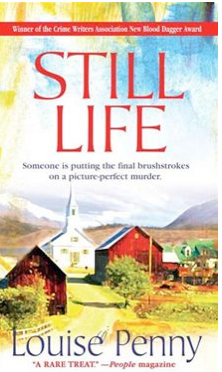
BOOKS: Louise Penny, Still Life

A sweet-sour “womens” tea cozy genre mystery novel about a Murder in Three Pines village - don’t go shopping for a country home in this town. I warned you.
Oh my. What a strange, haunting, cozy/dark detective series. Cutesey gentrified Quebec village, flakey croissant and lavish bistro dining interludes are juxtaposed with raw revelations of turbulent human emotion and behavior. A benevolent, wise, unjaded superintendent anchoring the investigations. Quirky village inhabitants involved with higher information age self-realization pursuits. Their interior lives and personal relationships are deftly revealed; they are not spared their pains and insecurities despite their "good life" environment. A nasty successful poet is tolerated by her neighbors. Teenage boys throw manure and curses at the gays who run the B&B. A troubled teen lies about his father. Another painter's mother kept snakes in the basement. 

Clara is the touchstone of the village, an artist who gets food in her hair when she eats. We're still supposed to find her charming anyway, and do. Her successful artist husband Peter is brooding and arrogant, I think, and yet she seeks him always. It's she who "solves" the mystery , because she is the princess who can discern the pea beneath the twenty mattresses; she notices an subtle change in her dead friend's last painting which reveals the killer. 

I like the way that art and appearances are written about in this novel particularly well. The author has the unique gift to describe appearances that become visual after the text, not an easy task. The murdered spinster's oeuvre, I imagine to be a fusion of Magritte, Grandma Moses, and James Ensor, based on the description, and it's very engaging and funny, too. 

Canadian vernacular references go undefined but add color. What is a licorice pipe? What would one order from Eaton's Catalog?  

Whimsical, funny, political, and philosophical/poetic author's voice comments are leavened into the chapters as well, making the novel work on narrative and emotional levels. It's not flat, procedural, or distanced. Rather, the reader pulls back from the revelations and human mistakes made, and it's Gamache, kind, avuncular, priest-like, who seems to bless away the pain, not without grieving himself, however. He remains, finally, merely authoritative, a man one doesn’t cross. 


I am going to have to wait a bit before I read the next one, though. The creepy fallout from this novel is going to linger in my memory

Monday, September 24, 2012

ART EXHIBIT: Gustav Klimpt at the Getty Museum


The Beethoven Frieze -  The Hostile Forces, 1902
I’ve read a biography of Klimpt which focussed on his erotic nature and its expression, and his mature work - I don’t recall it included so much about his early developmental period of Art Nouveau -historicism-realistic-Academic style.  It is simply, unsurpassingly magnificent.  More lush, more poignant than David, more sympathetic.  What a leap the Vienna Secession truly made into modernity - in some ways more astonishing than the French Moderns; its natural energy was tragically cut by World War I, the flu epidemic, and the economic and political destruction suffered in the ensuing years.  
Klimpt was a decorative graphic designer mural artist with the soul of a German romantic expressionist.  In him, the element of line has an apogee that perhaps hasn’t been matched, though much emulated.  It combines with elegance, modern psychological insights, and a tragic view of humans always suffering, with little respite.


 portrait of a Lady with Cape and Hat, 1897-1898, Gustav Klimt. Black and red crayon. Albertina, Vienna (from Getty website)


One of Klimpt’s early  charcoal works - the elegantly languid, moody and remote Viennese women he loved to draw and paint.


DANCE REVIEW: LA Dance Project Review


DANCE REVIEW
Better curated than choreographed
BY LEWIS SEGAL
   As a choreographer, Benjamin Millepied arguably brings nothing new to the Southern California dance scene beyond the scale of his ambitions. But as a curator he’s made his L.A. Dance Project a unique cultural resource with an inaugural performance dominated by the kind of daring, world-class contemporary revivals that our homegrown companies lack the will or budget to attempt.

   In a three-part program at Walt Disney Concert Hall on Saturday, Millepied’s quasi-local ensemble danced the first performance anywhere of Merce Cunningham’s controversial masterwork “Winterbranch”  (still photo left) since it left the Cunningham company repertory in1976. [Comment:  masterwork?  If you could see it or stand to listen to the extremely loud score - which followed another maddeningly repetitive and naively ageing off-key voice quavering endlessly about Jesus’ blood - ugh - I still can’t get it out of my mind.]  

   Abstract Expressionism at its most extreme, this1964 sextet remains oppressive in its pervasive darkness punctuated by occasional, random flashes of blinding light; in its silence shattered by a deafening, abrasive score (La Monte Young’s “2 sounds”); in its movement concept: all human activity — individual or collective — collapsing helplessly to the ground….The original production evoked the Holocaust to some observers… I do really want to see the dancers, not struggle to perceive their movements; I could only react by emotionally, aurally, and visually shutting down while this piece was performed.  What about Kronos Quartet “Black Angels”?   That’s tough enough for anyone’s apocolypse scenario, you think?

   If this seminal act of movement theater couldn’t display L.A. Dance Project’s technical prowess, ( because no one could see it, or the costumes touted as Rauschenberg’s “design” - what, he went shopping to Target and bought exercise clothes?   William Forsythe’s innovative 1993 “Quintett” certainly could and did, marred only by a sound system that reduced to mush the vital orchestral component of Gavin Bryars’ “Jesus’ Blood Never Failed Me Yet.”

   Against Bryars’ evolving, deepening sonorities, Forsythe turned classical ballet inside out: warping it, twisting it, adding infusions of sports movement, ordinary (pedestrian) action, gestural accents, even shake-that-booty pop dance — but never overloading it or making the dancers into faceless instruments.
... What’s more, the logistics of dance at Disney Hall served “Quintett” brilliantly, putting the audience in the same space as the dancers and helping all the choreographic components pop out with great immediacy.  I disliked the seeming inability to attempt lighting beyond placement of a few studio-type spotlights.

   Millepied capitalized on that immediacy in the premiere of his “Moving Parts” to a violin, organ and clarinet score by Nico Muhly, played live above the stage. music was fresh, living corrollary to the dancing

   But here, unfortunately, his very, very ordinary choreography was continually upstaged and eclipsed by the exemplary dancing and the cleverness of the staging.

   Yes, it was fun to watch the dancers manipulate Christopher Wool’s portable calligraphic scenic panels, reframing the performance dynamically many different ways.  Not so fun, they looked clunky and inserted - couldn’t Wool come up with anything more imaginative than just large canvasses, really now?  Furthermore, they looked like dated graphic design inspired by Stephen Heller or a student project at Art Center.  I liked the dancing but without toe shoes modern dance just doesn’t get the elegance or movements possible in dance, lifts almost always look clunky - can’t anyone do them?  And can’t white dancers jump?  Or is it just that white choreographers can’t create leaps and jumps as part of expressive movement vocabularies?    Nonetheless, I saw exquisite dancers and fascinating, sometimes difficult work that deserves to be in the repertoire of a truly modern company, especially the Forsythe work, which was  truly marvelous.     But the choreography itself had scarcely any movement invention to recommend it, except possibly in the second art during a throwaway cluster maneuver and a more developed duet for Lugo and Nathan Makolandra.

   Not wholly romantic, or competitive or out for gymnastic display, that duet was all over the map expressively — like most of the Millepied choreography that local audiences have seen — and ended with the dancers quizzically backing away as if silently asking the same question that some of us were asking: What was it that just happened ?

   You might argue that L.A. Dance Project is a New York company that had an extensive international tour booked about the time its local identity was signed and sealed with Music Center funding... Perhaps it will also become Lyon Dance Project or Sadler’s Wells Dance Project in its partnerships with foreign entities...  Besides the dancers mentioned, the Project personnel included Amanda Wells and Julia Eichten, plus musicians Phil O’Connor, Lisa Liu and Muhly.