Sunday, April 19, 2015

TRAVEL: Back to southern Utah again Vegas and Zion

LAS VEGAS


A next morning meet-up point with Jane and Lanny, my brother and my dear sister-in law Jane. An evening dinner and stroll at Bellagio.  The mood is festive, driven, streaming international family groups all going some place important to them.

An evening is Las Vegas is a premium experience in ambivalence.  Seduction, delight of novelty, twins with high moral dudgeon over the supreme waste of humanity's capital. 

It was particularly acute at dinner. Our Chinese restaurant, Noodles, served the best Asian fusion cuisine we've ever had. No gambling appointments seemed available at our table, not the usual Vegas casino dining experience.

Our sincere Asian waiter conveyed our compliments to the chef and I believed they were really pleased in their achievement.  Why do I have to go to Las Vegas to find such a good pure thing?  Why are they there instead of in a neutral zone in which I won't be compromised by guilt?

The Bellagio, I recall, redefined Vegas class when it opened.  It was quite ghastly, the faux-italianate lobby and garden areas overloaded with mass paper craft Chinese and Asian floral garlands, trees, kites. A wonderful floral fragrance was fresh and pleasurable.  And service so good, amidst the throng, concierges assisted us, and we found a lovely Parisian pastry shop with a chocolate fountain.  Quite fun. The chocolate dipped fried Twinkie John had the next day in 
Springdale was better, though.  
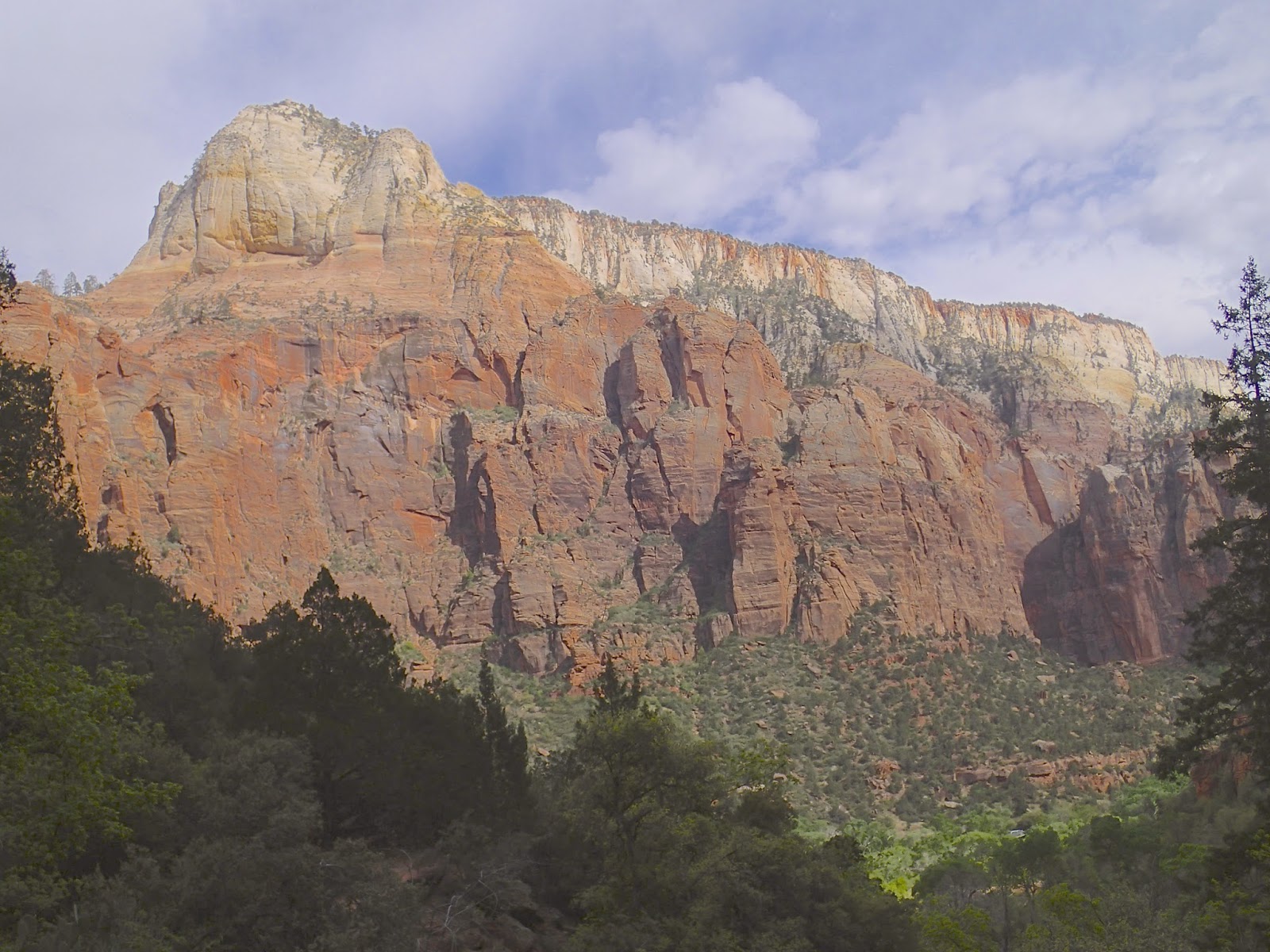


The next morning, on to Zion, one of our favorite places, for two warm sunny days.

Springdale is a lovely non-restuarant franchised  town, plenty of franchise motels, however, nice to stay in to visit the incomparable Zion.  The canyon walls are close and distant at once, making awe an intimate experience.

The formations are named by devout Mormons from Biblical references, and it is so perfect, my head dips and a small silent prayer goes up.  God is still "up there", in my so limited comprehension of Zion and environs.


The river is a quintessential western canyon stream-riverbed.  As the canyon narrows, it draws you in, a celebration of time no museum can endeavor to present. Water, wind, sandstone, minerals.  Geology's art materials, conformed by variables so complex
the mind struggles to follow the progressions and regressions of each, and the scientists prognosticate yet.   

Jane and I are hiking the river now, on a warm day with our feet and legs in 45-degree water, strangely not very cold.  I guess a nature high discards worry about discomfort as an unworthy backstory.  Except for bragging rights.  


Narrowing canyon walls as we hike against an insistent current, and on sandbars that give a change of resistance necessary to apply in one's steps.


How lovely the rivulet waterfalls that slide simply down the canyon sides.  Children trudge across to stand or lie on them, giggling at the tickling water entering the backs of their shirts. An excellent idea.


It's wet, it stays wet, as long as there's flow from above, and moss, ferns and mineral algae stains create yet another vegetation climate contrast.  Maidenhair ferns overhang in such dry chaparral country - would anyone have guessed it was possible?


The Narrows of the Virgin River - rated as one of the world's ten best hikes.  Since I've only done 2 of the ten, I really can't comment, except to say "love the one you're with".

The sturdy hikers, looking like Italian great-grandmothers walking up a street in Cortona.  

Jane is clearly the foolish Auntie Mame figure here, and I am close to the dignity and slyness of Maggie Smith's paternal grandmother of Downton Abbey.  We are perfect together.


The sun works hard to enter the canyons, and mostly can't. One hops from north to south, east to west, looking for lighting that will serve a camera lens.  Good luck.  The contrasts are the reality here - harsh, changing, abrupt.  The sun falls behind the canyon wall, and it's dark, somber, like walking in Venice trying to find...your hotel, restaurant, etc., but instead, find another wonderful square or plaza with another magnificent church to enter and gaze upon.

Flora of the West...a lovely amazing footnote of quizzical encounter - what does this plant tell about its reasons for existing in this place, now?  Why its perfect relation of form to environment? A growing plant is always saying yes.
yellow salsify
A bold thistle-like plant along the Virgin River in a place where the canyon widens and chaparral gives way to higher elevation ecology.
shooting star
Under a trickling waterfall, an anomaly that really is not, merely a function of the reality of variety that all renounce in favor of abstraction, classification, and deductive reasoning, revealing the fallacy of generalizations.
prickly pear cactus in bloom
The marvel of a cactus flower - a rose overstated, the intentions similar.  Protect the seed; injure those who intrude without care.


Jane and I, the intrepid ones, drive out of Zion together and hike the view trail looking back and into the canyon.  A delightful and sad aloha.
What would become a more familiar expressive rock formation - this is the "Checkerboard", an exposed bare sandstone cliff that has been eroded by both water and wind, dividing it into rectangles and squares.


Wednesday, April 1, 2015

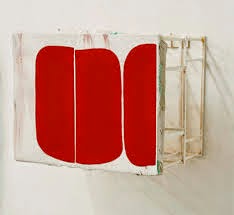
PAINTING: Jim Lee

I am stimulated and excited here.  This painter is doing things with the surfaces, wood, collage and constructions which are so unified and clean and evocative and engaging spatially.

I have ephemeral unfocused urges to paint and use wood materials, scraps of canvas, stuff, maps, but can't figure out what to do with them, now I'm going to try.

I'm going to get an old palette and paint on it just let go and do it.


Friday, February 27, 2015

ART: ADMIRED PAINTERS LIFE LIST

THIS IS A LIST I KEEP AND TEND frequently.
It's meant for me to keep as benchmarks for my artistic life, touchbacks for reflection.

4-1-15   LOIS DODD

A loner figurative artist I place in a loose group with Neil Welliver, Fairchild Porter, and Charles Burchfield, other east coast figurative painters I cherish for their deep and abiding love and depiction of nature.  I love it that she's loose, gestural. She's old, lives modestly. Has a following.


2-27-15  JOYCE KOZLOFF
One of the founders of the Pattern and Decoration Movement, to which I am drawn because of it's joyous celebration of visual delights.  Scully says we create because we are divided.  P&D I think comes from the need to fill the void, and because it serves human needs for visual complexity and novelty. 


2-26-15  KIM MCCONNAL
2-27-15 ROBERT KUSCHNER


2-26-15  EGON SCHIELE
1914
I love the attenuated, hungry, bold angular geometries, the powerful delicate line, the guiltless and forbidden quality of Schiele's celebration of sexuality, 


Marlene Dumas


MARK ROTHKO

VINCENT VAN GOGH

RICHARD DIEBENKORN

MILTON AVERY

AGNES MARTIN

GEORGIA O'KEEFFE

PAUL KLEE

RACKSTRAW DOWNS

FAIRFIELD PORTER

WINSLOW HOMER

CAMILLE PISARRO

JOHN SINGER SARGENT

RUSSELL CHATHAM

PETER DOIG

WAYNE THIEBAUD

EDWARD HOPPER

ROBERT MOTHERWELL

JMW TURNER

EDOUARD MANET

SEAN SCULLY

RICHARD POUSSETTE-DART

JOSEPH CORNELL

BRICE MARDEN

ROBERT RYMAN

MIRIAM SHAPIRO


HELEN FRANKENTHALER


CHARLES BURCHFIELD

EDGAR DEGAS

CHARLES DEMUTH

DAVID HOCKNEY

MAYNARD DIXON

MARTIN JOHNSON HEADE

FREDERICK KENSETT

ANTONI TAPIES

MORRIS GRAVES

MARK TOBEY

HENRI MATISSE

CLAUDE LE LORRAINE

KEHINDE WILEY

James Turrell

Andy Goldsworthy

Barbara Hepworth


Bridget Riley

... a unified and balanced field of visual sensation which, at the same time, is organised dynamically in terms of individual colours. 

similar and contrasting colours in a way that sustains a saturated intensity of colour across the entire picture plane...


Thursday, February 26, 2015

ART: Kehinde Wiley Retrospective at Brooklyn Museum

Riotous, controlled, excessive, Dionysian… I've always responded viscerally to Wiley's work, detouring and excusing the superficiality, pastiche.  Roberta Smith's #tags are a helpful reset : " conceptually provocative…thin, indifferently worked surfaces (because he uses lots of helpers)..ecstatic interplay of cultures…exposure of bigotry…contemporarily seductive…raises issues about workshop production and the role of the artist..formula of repeating elements (decoration, pose, garments, props…)". (NYT)

They do make me laugh, and having known as many young black people as I did, I find them poignant. So grand, crazy, a display of status, power, all conveyed by a rigid, brittle and deeply fashionable style, mocking its pretensions while taking delightful revenge is having it all.  

I also value the art-history references, perhaps overmuch, but they do balance the social instrumentalism problem of artistic intention. 

Saturday, February 14, 2015

ART; Perceptual Painters Group

 Elizabaeth O'Brien, downloaded from Perceptual Painters newsletters

I found this group though FB networking. They are a group of figurative realists concerned with observation, "seeing", valuing, plain air and perceptual painting approaches drawn from Impressionism, American Luminism, Edward Dickinson, Charles Henry Hawthorne, and Henry Ensche, I think.  

Elizabeth O'Brien reminds me of Charles Burchfield in mood, tone, and palette. 

Wonderfully engaging composition and delicate moody color sense.


Friday, February 13, 2015

ART: In Search of Painting Instruction

Last week I networked a Facebook group recommended to me by a former teacher.  She had taught a complicated color theory program that seemed to promise limitless sources of luminosity.  I had become obsessed with the exercises, enjoying the discipline and spectacle of mixing color.  What endless pleasure I get from seeing the magic of color changes.  

That group was the Students of Henry Hensche, who was a Provincetown teacher espousing Charles Hawthorne, an influential teacher also, with roots in American Realism and Tonalism.

I wish I liked Hensche's Impressionist-derived paintings.  It's even harder to like much of his students' work.  It's very high key, strident, and plodding genre landscapes. Some of the colorists remind me of Pierre Bonnard's vivid palette, though Monet's 4 Poplars seems to be the main inspiration - its orange and blue color harmony is endlessly used by HH students to give a kind of unhealthy high key glow to their work, as if it had gotten an airbrush suntan treatment.    

What seemed important was HH's emphasis on plein air discipline and perceptual training, observing color and nuance and translating it from a visual perception to the canvas.

One of the individuals recommended the Perceptual Painters Group, a contemporary realist group making very lovely work.  They send a newsletter which I enjoy seeing very much.  So good to know all these painters in the heritage of American Luminist Realism exist. 


Wednesday, February 11, 2015

ART: Autry Museum; Floral Beadwork & Masters of the American West Art Exhibit

On a grace-filled southern California winter's day, white branches of the sycamores triangulate our singularly blue skies. A remarkable and moving exhibit of women's artistry and patience calls me. And I want to see the Western paintings chosen for exhibit  - what's seen as exemplary, worthy of sale?

NATIVE AMERICAN FLORAL BEADWORK EXHIBITION

What happened to the culture of Native North Americans during encūentro is similar to that of other societies whose patrimonies held rich worlds of unique beauty and identity.
octopus beaded bag

European missionaries and traders introduced glass beads, fabric dyes, yarns, craft and art techniques, and Christianity throughout the world. Indigenous products began to be manufactured for trade and collection, the designs modified and interpreted to suit occidental, colonial tastes.  The authentic cultural product was just too strange and uncomfortable, too powerful evidence of the exploitation and domination taking place. 

And yet the beauty remains, the humanity manifest, immanent.
online photo

So we have Chinese and Japanese export ceramics, Indonesian and Indian textiles, African ivory figurines, Hawai'ian quilts, Samoan-style tattoos. 

Native Americans already beaded with shells, porcupine quills, seeds, and bones, mostly with geometric and abstract symbols that were deeply connected to their religious practices.  

Now their beadwork designs began to use trade beads and include secular European floral motifs. But the Native Americans combined them with their own cosmological symbols.  Frequently a cross that symbolizes the cardinal directions is worked into the overall design, for instance.


photo from Cree art reference website, Birmingham Museum
This is a Cree head-covering designed for wear by women attending Christian churches. The sides would limit peripheral vision and conceal much of the face and hair, like a nun's coif, the similar purpose. In the center of each rose winding around the face appears the cardinal directions symbol, retained and integrated into the design.  It's one of the most moving objects in the exhibit, symbolic of how  Native Americans at once submitted and sustained their culture even as their world was destroyed.
photo retained from online search

Even more evocative is the collection of moccasins.  A large group fills one wall, decorated soft foot coverings.  In most of them, one can see the shapes of toes and arches retained by supple buckskin.  Sometimes one is slightly larger than its mate, revealing the anatomical disparity of foot size or the preferred lead walking foot.

Where do those feet tread now?  I hope they may be wind spirits, that I can put my face up to them and tell them that we venerate them in our tragically compromised fashion.  


WESTERN ARTISTS YEARLY SALE EXHIBITION
George Carlson, Witness of Time

Contemporary western genre art to be seen here, mostly cowboy and Indian portraits and historical action narratives.  I want to like them, and do, but it's the landscapes that I will love unequivocally. 

The paintings are beautifully well-executed, unabashedly realist, detailed, lovely warm-toned images, leaving me impressed by the painters' mastery of technique. So what's not to like?  They are attractive, innocent. It's not about liking. So I worry.

Are they perhaps clichéd, grounded in sentimental populist nostalgia, less authentic as a consequence?  There is also the problem of intentionally or unintentionally commodifing Native Americans, and Western history itself. 
Jay Lipking, Young Girl, Profile

I love Western movies, but why paint them? Narrative genre painting is trumped by historical photography and then marginalized  by modern cinema. Photographs by Edward Curtis, a George Catlin painting; I feel on more authentic ground with these. So there is is: the compromised intention makes for compromised results.

I think landscape painting seems to be on more stable political and artistic ground. The earth and its natural beauty are ageless metaphors for spirituality and transcendence, identity,survival, the American frontier and way of life. They are especially poignant as we live with the reality of the degraded beauty of wilderness. 

An artist who chooses landscape, eschewing abstraction, can still be viable, though perhaps will never be fully appreciated in today's commercial museum scene. 

These are the landscape painters I most admired in the exhibit:
Lon Chmeil, Unseasonable


Jerry Lipking, Riders, Vermilion Cliffs

Jay Moore, Moonlit Night

George Carlson, Witness of Time


Lon Chmeil, Geological Illusion

Carole Cooke, Mist over Logan Pass

Carole Cooke, Windswept